Practice Management

At one time or another, every primary care physician will likely see a patient who is a hypochondriac, a chronic complainer, or a substance abuser. Rather than seeing these patients as difficult and avoiding them as much as possible, the physician can reframe the problem as an opportunity for growth and development. Dr Lieberman suggests that keeping the sessions brief but allowing more frequent visits and addressing medical and psychosocial concerns will make your relationship with your patient more positive. Managing hypochondriacal patients, chronic complainers, and substance abusers will be much easier after listening to Dr Lieberman’s suggestions.
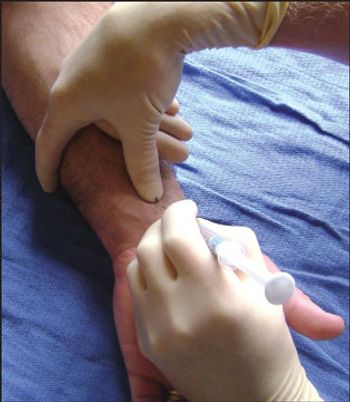
A common method used to locate the radial artery involves palpation of the radial pulse with 2 or 3 fingers of the nondominant hand, followed by an attempt to puncture the artery with a needle held in the dominant hand.

Road Burn

The treatment of road burn-the abrasions caused by falling on an asphalt or gravel surface, such as a school yard-can be eased and expedited by the application of a topical anesthetic.

To save time and minimize pain and tissue trauma when injecting a joint or soft tissue with a corticosteroid, use a single needle and 2 screw-on syringes. Fill the first syringe with lidocaine and the second with the corticosteroid, then lightly but securely attach the first syringe to the needle. After inserting the needle and achieving local analgesia in the desired location, simply leave the needle in place and, while holding it firmly, switch the syringes; then inject the corticosteroid.

Pant Like a Puppy

Sometimes it is impossible to see beyond the tongue of a child who has a sore throat.

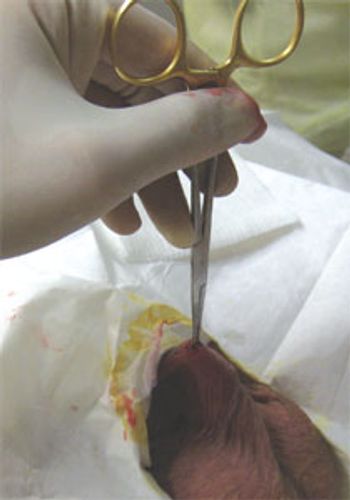
Vasectomy is a safe and effective form of sterilization that about half a million men in the United States undergo each year.1 Dr Li Shun-Quiang first introduced the no-scalpel technique of vasectomy in China in 1974.

When removing sutures that are tight or for any reason difficult to get scissors under, I use a No. 11–blade scalpel, with the blunt side down and the sharp side up beneath the suture to be cut.

Visualizing ear wax while attempting to remove it can be difficult. To make the process easier, I enlist the patient’s help. When examining the left ear, I have the patient grasp the ear with the right hand, at about the 2-o’clock position.

Elastic Bandage Ankle Brace

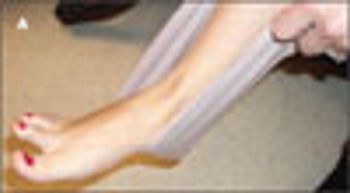
Although ankle injuries are common, many office practices do not have commercial ankle braces readily available. A supportive ankle wrap can be readily created with two 4-inch elastic bandages (3-inch bandages in smaller patients), using the following technique:

Sometimes trying to locate a tiny shard of glass in the sole of the foot is like looking for a needle in a haystack. Even after a radiograph confirms the presence of the glass, it still may be difficult to findÑespecially in the thicker heel pad.

Removing a Fine Line

Here are some of the best tools to keep on hand for removal of fine sutures.

To irrigate a contaminated wound quickly, punch 3 holes in the lid of a 500-mL container of normal saline with a 14- or 16-gauge sterile needle. Invert the bottle and squeeze.

Cerumen can sometimes be so impacted that irrigation is ineffective. A good way to loosen it is to have the patient reach up over his or her head with the hand on the side opposite that of the ear being irrigated and grip the pinna by the helix.

Funnel Splash Shield

When normal saline and a syringe are used to perform wound lavage, a small sterilized transparent or semi-transparent plastic funnel makes an excellent splash shield.

Although many lacerations are treated in the emergency department, primary care clinicians still see their share of such wounds. Most lacerations are incurred on the face and head (as a result of falls or altercations) or on the hand or lower arm (caused by tools, broken glass, or other sharp objects).