

Expert faculty demonstrate how thoughtful screening and careful interpretation can help primary care clinicians recognize hypercortisolism earlier and with greater confidence.
Expert faculty demonstrate how thoughtful screening and careful interpretation can help primary care clinicians recognize hypercortisolism earlier and with greater confidence.
Recognizing hypercortisolism is only the first step. Expert faculty discuss how thoughtful evaluation, strong clinical advocacy, and coordinated referral can help patients receive timely diagnosis and appropriate care.
Expert faculty examine how resistant hypertension may signal underlying hypercortisolism and discuss when clinicians should think beyond routine blood pressure management.
Expert faculty discuss how treatment outcomes and emerging evidence strengthen the case for earlier recognition of hypercortisolism in primary care.
Expert faculty demonstrate how practical hypercortisolism screening can be in primary care when clinicians know which test to use and how to use it.
The panel of experts examines how the CATALYST trial is changing the way primary care clinicians recognize hypercortisolism in patients with difficult-to-control type 2 diabetes.
Patients who keep missing treatment goals despite good therapy may be facing an unrecognized hormonal driver that primary care is now positioned to catch early.
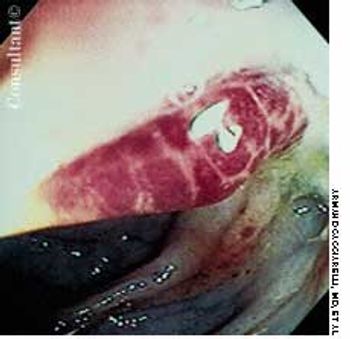
A 2-week history of diarrhea mixed with bright red blood was the presenting complaint of a 40-year-old man who was seropositive for HIV. Stool studies and culture results were negative for microorganisms. Colonoscopy demonstrated only the raised vascular lesion seen here in the sigmoid colon, which may have been responsible for the bleeding.
September 14th 2005