Fendrick considers the current state of colorectal cancer screening in the US, emphasizing limited colonoscopy capacity and patient preferences for at-home tests.
Fendrick considers the current state of colorectal cancer screening in the US, emphasizing limited colonoscopy capacity and patient preferences for at-home tests.
Primary care faces a colorectal cancer screening backlog. Mark Fendrick, MD, describes noninvasive testing and mandatory colonoscopy follow-up.
Physician researcher Fendrick offers an expert perspective on why removing cost barriers matters, and why navigation and patient realities still determine whether CRC screening succeeds.
Fendrick discusses the balance between colonoscopy and non-invasive tests for colorectal cancer screening, aiming for better patient outcomes.
Completion of the screening pathway—not test selection alone—may define quality going forward.
Moving patients from considering screening to completing it remains the central challenge in colorectal cancer prevention, Fendrick explained to Patient Care.
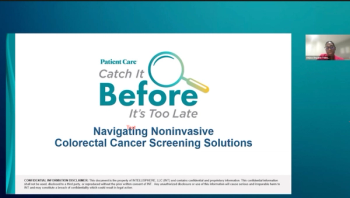
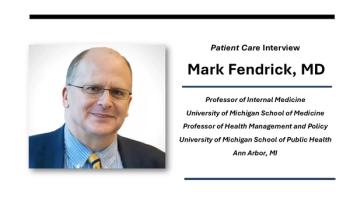
Only about 75% of people with a positive result on a stool-based test for colorectal cancer complete screening with a colonoscopy. Fendrick "won't rest" until it's 90%.
Mark Fendrick, MD, thinks that right now, the relative accuracy of blood-based tests for CRC compared with available alternatives is not quite comparable. He explains.
With a population goal of having 80% to 90% of age-eligible Americans screened for colorectal cancer, colonoscopy can not be the initial test for everyone, Fendrick emphasizes.
Never considered the carbon footprint left by a screening for colorectal cancer? Fendrick has and did the research to learn more. He explains in this short video.
The increase in stool-based CRC testing is a logical trend, Hendrick said in an interview, given the convenience plus the 2 million younger adults now eligible for screening.
October 30th 2025
October 30th 2025