

All News

ABSTRACT: The increasing availability of bedside ultrasonographyallows for more timely diagnosis and treatment of pleuraleffusion while limiting the patient's exposure to radiation. Thedynamic signs characteristic of pleural effusions includerespirophasic changes in the shape of the fluid collection, floatingmovements of atelectatic lung, and the plankton sign. Ultrasonographyalso is an efficient means of excluding pneumothoraxwhen rapid diagnosis is needed or after interventionssuch as central line placement, lung or pleural biopsy, or thoracentesis.The diagnosis of a pneumothorax relies on the absenceof dynamic signs such as "lung sliding." Static signs, suchas the comet tail artifact, or consolidated lung parenchyma orlung tissue that contains a solid mass, also can be useful in excludingpneumothorax. Ultrasonography can be used to guidefine-needle aspiration and core biopsies of pleural nodules,pleural thickening, and subpleural lung masses. (J Respir Dis.2008;29(5):200-207)
ABSTRACT: The risk factors for health care–associated pneumonia(HCAP) include hospitalization for 2 or more days withinthe past 90 days, residence in a nursing home or extended-carefacility, home infusion therapy, and long-term dialysis withinthe past 30 days. Distinguishing between community-acquiredpneumonia (CAP) and HCAP is important because of the implicationsfor therapy. Compared with CAP, HCAP is morelikely to be caused by multidrug-resistant organisms and is associatedwith a higher mortality rate. The management ofHCAP requires antimicrobial coverage of Pseudomonas aeruginosa,Acinetobacter species, extended-spectrum ß-lactamase–producing Enterobacteriaceae, and methicillin-resistant Staphylococcusaureus. Empirical narrowing of therapy is probablysafe in patients with culture-negative HCAP who have improvedwith broad-spectrum therapy. (J Respir Dis. 2008;29(5):208-213)

After a family argument, an 83-year-old woman experienced chest pain, a "racing heart," and a choking sensation and was brought to the emergency department. The chest pain lasted 10 to 15 minutes; was sharp, substernal, and nonradiating; and was associated with dyspnea and a bout of emesis. A sublingual nitroglycerin tablet partially alleviated the pain, but the patient felt syncopal. Her symptoms persisted despite the administration of supplemental oxygen and a second sublingual nitroglycerin tablet. The patient had a history of gastroesophageal reflux disease, allergic rhinitis, and osteoarthritis. Her oral medications included esomeprazole (40 mg/d), aspirin (81 mg/d), and fluticasone nasal spray. She had discontinued valdecoxib 3 weeks earlier.

Caroli Disease

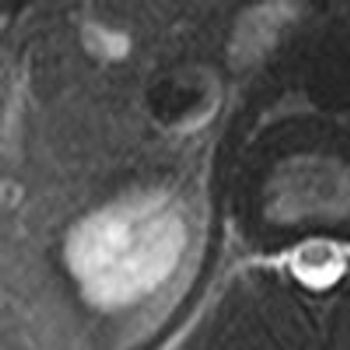
Caroli disease had been diagnosed in a 29-year-old man 5 years earlier based on MRI findings of multiple sacculated, dilated intrahepatic ducts with intrahepatic calculi and calculi in the common bile duct. At the time of diagnosis, the patient had no significant medical history and was asymptomatic. Regular follow-up, including annual serial MRI scanning of the abdomen, was recommended.

Since pertussis has been considered to be primarily apediatric disease, it is often overlooked as a cause of cough inadults. However, the incidence has been increasing in adolescentsand adults, and these persons are the major reservoir forthe disease. The first stage of illness is characterized by flu-likesymptoms; then patients typically have paroxysms of severecoughing-several short dry coughs, followed by a deep inspiratoryeffort and the characteristic "whoop." The most commoncomplication of pertussis is pneumonia, but other complicationsinclude bronchitis, laryngitis, atelectasis, pneumothorax,subconjunctival hemorrhage, subdural hematoma,and seizures. The diagnosis can be confirmed by isolation ofBordetella pertussis in culture; rapid diagnostic tests, such as thedirect fluorescent antibody method and polymerase chain reaction;and serological tests to detect antibodies to B pertussis.First-line therapy for pertussis includes a macrolide antibiotic.(J Respir Dis. 2008;29(4):172-178)

The American College of Chest Physicians (ACCP) has established guidelines for the prevention of venous thromboembolism (VTE); however, a recent study by Amin and associates documents a very low rate of adherence to these guidelines in acute-care hospitals in the United States. In fact, they found that about two thirds of at risk medical patients are not receiving appropriate VTE prophylaxis at the time of discharge.

Many physicians consider oral antihistaminesto be the first-line therapyfor allergic rhinitis. While theseagents effectively reduce the symptomsof itching, sneezing, and rhinorrhea,they do not have much ofan effect on nasal congestion. Intranasalantihistamines appear tohave an edge over the oral agents inthat they do reduce nasal congestionand they have a rapid onset ofaction. A recent review of the literatureprovides additional evidence ofthe efficacy of intranasal antihistaminesin the treatment of both allergicrhinitis and vasomotor rhinitis,which is the most common formof nonallergic rhinitis.

If you have ever been confounded by a case or have correctly interpreted a subtle finding, then you probably have encountered a diagnostic puzzler that you might want to share with other readers of The Journal of Respiratory Diseases.

A 43-year-old homeless woman presented with a 2-week history of fever, chills, sweats, generalized pain, and cough that was productive of purulent green-yellow sputum mixed with blood. She reported a 15-lb weight loss over the past 6 weeks.

Although the results of a thorough history and physicalexamination often suggest the diagnosis of asthma, confirmatorytesting is required and may be helpful in more subtlecases. Spirometry before and after bronchodilator administrationis the first step for the initial diagnosis; it also is an importantcomponent of the long-term assessment of asthma control.When the results of spirometry are normal in a patient in whomasthma is suspected, bronchoprovocation challenge testingwith methacholine is generally considered the next diagnosticstep. Numerous alternative methods of bronchoprovocationtesting have been developed, such as the challenge with adenosine5'-monophosphate. Novel methods such as the forced oscillationtechnique and the measurement of exhaled nitric oxidehold promise for more effective diagnosis and monitoringof asthma in the future. (J Respir Dis. 2008;29(4):157-169)

A 5-month-old boy presented with fever, cough, and tachypnea that he had had for 1 month. There also was a history of poor weight gain for 2 months. The child was born full-term at a private hospital, and the mother's antenatal course was uneventful. There was no postnatal history of bleeding, jaundice, diarrhea, poor feeding, vomiting, or seizures. There was no family history of tuberculosis.

The foundation of arterial blood gas (ABG) analysisconsists of determining whether the patient has acidosis or alkalosis;whether it is a respiratory or metabolic process; and,if respiratory, whether it is a pure respiratory process. If the patient'spH and PCO2 are increased or decreased in the same direction,the process is metabolic; if one is increased while theother is decreased, the process is respiratory. In a number ofclinical situations, pulse oximetry is preferred to ABG analysis.However, pulse oximetry may not be accurate in patients whoare profoundly anemic, hypotensive, or hypothermic. Whilevenous blood gas (VBG) analysis does not provide any informationabout the patient's oxygenation, it can help assessthe level of acidosis or alkalosis. VBG analysis may be particularlyuseful in patients with diabetic or alcoholic ketoacidosis.(J Respir Dis. 2008;29(2):74-82)

Pseudomonas aeruginosa is a major cause of nosocomial infections, including ventilator-associated pneumonia (VAP). Effective management of pneumonia caused by this pathogen has been hindered by the increased incidence of multidrug resistance and limited treatment options. The results of a study conducted in Spain underscore the importance of choosing the right antibiotic-or combination of antibiotics-for the initial empiric therapy.

We present a case of a 52-year oldwoman with exudativepleural effusion. Her workuprevealed an ovarian tumor,and the effusion completely resolvedafter resection of the tumor.Pathology revealed granulosacell tumor, which is anunusual cause of Meigs syndrome.This case shows theimportance of considering abdominopelvicpathology in unsolvedcases of pleural effusion.

The case presented here illustratesthe diagnostic challengesand potential severity of a fungalinfection.