All News

A 68-year-old man with a prosthetic mitral valve presents to the emergency department with acute abdominal pain, nausea, vomiting, and constipation. Surgical evaluation is performed; the results suggest a complete bowel obstruction. Urgent celiotomy is recommended.

Preoperative Evaluation:

For patients with cardiovascular risk factors, the most serious complication of noncardiac surgery is a perioperative cardiac event, such as myocardial infarction or sudden death. The preoperative cardiac assessment is an essential tool for identifying patients at risk for cardiac complications and for recommending appropriate strategies to minimize risk.

Numerous flat, brown lesions with sharp, irregular borders had been present on the upper extremities, abdomen, back, and the proximal legs and neck of a 28-year-old woman for 4 months. The asymptomatic lesions--some with a narrow, slightly raised halo--were more pronounced on the anterior and posterior trunk.

A 14-year-old girl presented with concerns about a "deformed" right shoulder. Despite the fact that there was no associated weakness, the defect made her self-conscious. She denied recent trauma to the site and severe physical exertion.

For 3 days, a 10-year-old girl had redness and vesicles on her right volar wrist. She had not had any pain, fever, or other systemic symptoms.

An 87-year-old woman who recently moved to an assisted living facility from her home is seen for evaluation of facial edema and erythema after a bee or wasp sting sustained 2 days earlier. Patient denies pain, pruritus, or visual changes. She took one dose of diphenhydramine shortly after the event and has noticed that the edema, which affected primarily the right side of the face, near the sting, has improved.

A 10-year-old girl has had a worsening rash for 1 week. The mildly pruritic, nontender eruption initially appeared on the child's thighs and then spread to the arms and face. The child's right hand, feet, and ankles have been swollen for the past 4 days, which has made ambulation intermittently painful.

The metabolic syndrome represents a clustering of conditions and/or risk factors that lead to an increased incidence of type 2 diabetes mellitus and cardiovascular disease. These conditions include abdominal obesity, dyslipidemia, hypertension, insulin resistance, and a proinflammatory state.

An otherwise healthy 16-year-old girl presented with medial arm pain after falling on her left elbow while skating. Robert P. Blereau, MD, and Timothy J. Haley, MD, of Morgan City, La, write that a radiograph of the left upper arm showed a spur projecting from the distal humerus; there was no fracture or dislocation.

Euryblepharon

During a neurologic evaluation for seizures, a 17-year-old boy with epilepsy was noted to have a deformity of both lower eyelids. According to the boy's mother, the deformity had been present since birth; it was not related to the patient's neurologic condition.

Iron Deficiency Anemia

A 37-year-old woman presented with weakness, fatigue, and lethargy. Her only other complaint was heavy menses.

MRI Diagnosis of Bone Bruise

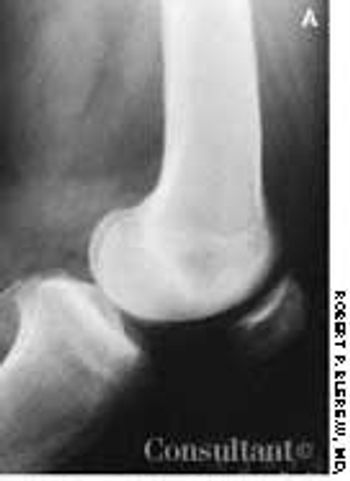
A 41-year-old man fell 3 ft into a bilge; he landed on his left leg and experienced immediate generalized pain in that knee. Three days later, he consulted his physician, who found minimal effusion in the knee and tenderness of the medial collateral ligament (MCL). No abnormalities were seen on plain x-ray films.

Labial Adhesions

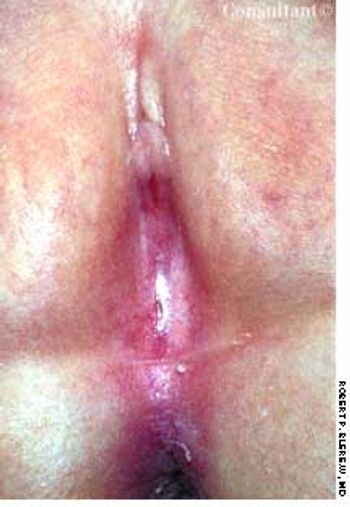
The mother of a 1-year-old girl observed that for 1 week her child seemed to be uncomfortable during the night and when she urinated.

Infantile Digital Fibromas

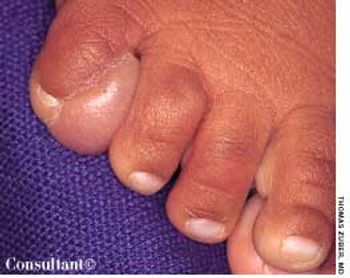
An enlarging mass was noted on the dorsum of the right fifth toe of a 2-month-old boy during a well-child examination. The firm, immobile mass measured approximately 1 cm in diameter. A congenital abnormality was suspected; the patient was referred to a plastic surgeon for consultation.

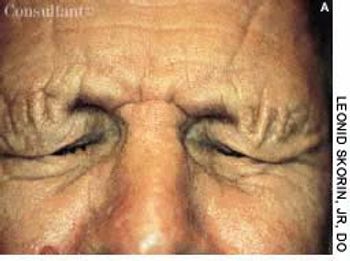
Progressive, uncontrolled blinking and eyelid spasms had begun 3 years ago and now rendered a 77-year-old man functionally blind. Various treatments, including oral and topical medications and acupuncture, had been unsuccessful.

An 83-year-old man with a history of hypertension and coronary artery disease presented with a 4-day history of mental status changes, slurred speech, and difficulty ambulating. He reported a lack of appetite and weakness of several days.

Paralytic Ileus

This obstruction is caused by a failure of intestinal peristalsis; there is no evidence of mechanical obstruction. Paralytic ileus is common after abdominal surgery, especially if anticholinergic drugs are given preoperatively and/or narcotics are used postoperatively. It usually lasts 2 to 3 days. Paralytic ileus may also be caused by peritonitis; ischemia or surgical manipulation of the bowel; retroperitoneal hemorrhage; spinal fracture; systemic sepsis; shock; hypokalemia; uremia; pharmacologic agents (eg, vincristine, loperamide, and calcium channel blockers); diabetic ketoacidosis; and myxedema.

A 56-year-old woman was referred for management of severe hyperlipidemia. Her family history included hypercholesterolemia and premature coronary artery disease.

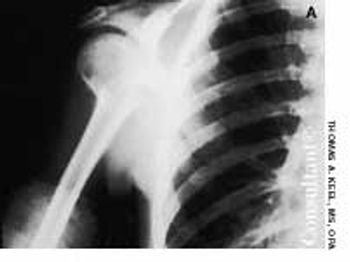
A 32-year-old man sustained a humeral neck fracture from a fall. A proximal humerus fracture often results from a fall on an outstretched hand is called a “FOOSH” injury.