
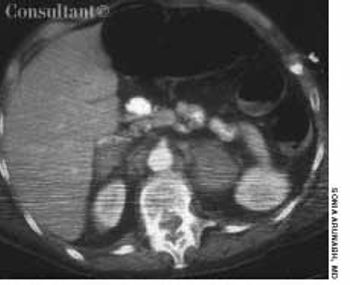
A 48-year-old woman was admitted to the hospital with deep venous thrombosis of the right leg. She had a history of non-Hodgkin lymphoma, which was in remission. The patient had been a heavy smoker for many years.
A 48-year-old woman was admitted to the hospital with deep venous thrombosis of the right leg. She had a history of non-Hodgkin lymphoma, which was in remission. The patient had been a heavy smoker for many years.
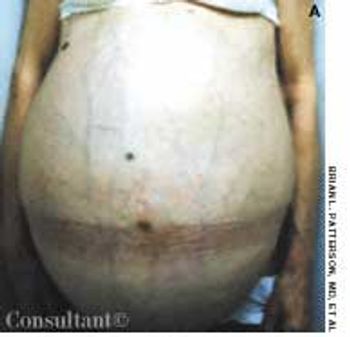
For 2 years, a 55-year-old woman's abdomen gradually enlarged; the pace of this growth had accelerated during the last 6 months. The patient, who had not seen a physician in 10 years, denied abdominal pain, nausea, vomiting, constipation, diarrhea, or any change in bowel habits. She had no shortness of breath or weakness. The patient reported no significant medical history, had no allergies, and took no medications. Her mother had died of ovarian cancer.

During a routine eye examination, a 74-year-old woman stated that her left upper eyelid drooped more than the right upper eyelid. The eye muscle imbalance had been long-standing; the patient denied diplopia.
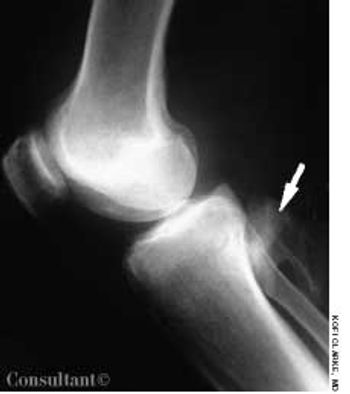
A 44-year-old man with a history of grand mal seizures experienced knee pain while walking. The pain was more severe in the left than in the right knee. The patient had a history of trauma to his left knee caused by falling during seizures.

This 14-year-old boy presented with slowly progressive hypopigmented lesions that had been present on the lower extremities for the previous 2 years.
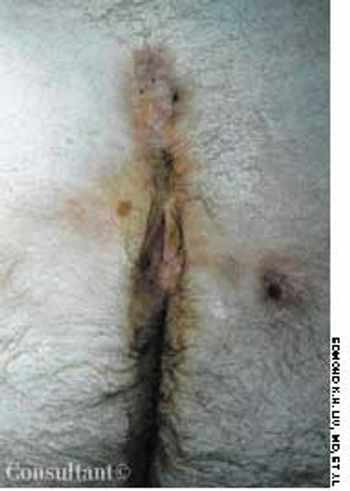
A 45-year-old man sought medical advice after suffering for 6 months with recurrent pain and a purulent discharge at the sacrococcygeal region. Two weeks before this consultation, an abscess on the patient's right buttock had been drained by another physician. The patient had insulin-dependent diabetes mellitus for 5 years; his medical history was otherwise unremarkable.
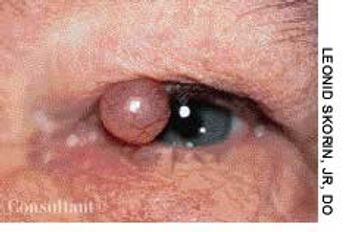
The painless lesion on this 66-year-old woman's upper eyelid had been enlarging for the past couple of months and was now obscuring her vision.

This disorder occurs in fetal development, when the midgut supplied by the superior mesenteric artery grows too rapidly to be accommodated in the abdominal cavity. Prolapse into the umbilical cord occurs around the sixth week of gestation. Between the tenth and eleventh weeks, the midgut retracts from its location at the exocelomic umbilical stalk back into the abdominal cavity. During this return, the midgut undergoes a 270-degree counterclockwise rotation about the axis of the superior mesenteric artery, followed by fixation to the posterior abdominal wall. Malrotation results from failure of the midgut to properly rotate and affix itself to this wall. This disorder occurs approximately once in 500 live births.
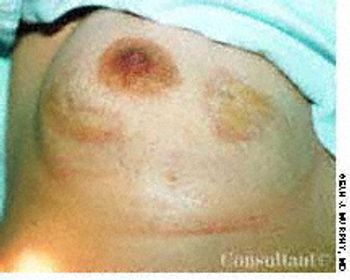
Two enlarging, dry, tender lesions had developed on the right breast of a 62-year-old woman 2 years before she sought medical consultation. The patient had no other symptoms; she was taking metoprolol succinate for cardiac arrhythmias.
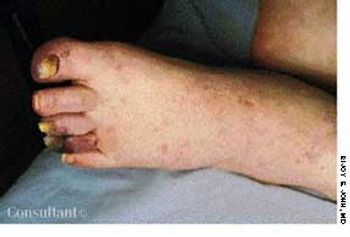
A 65-year-old man presented with bluish toes and petechiae on his toes and feet 3 days after having undergone renal angiography. Bilateral pitting pedal edema was noted, and laboratory tests revealed proteinuria, eosinophilia, and an erythrocyte sedimentation rate (ESR) of 65 mm/h.
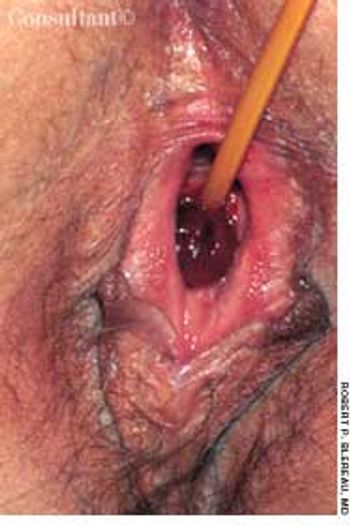
Following a cholecystectomy, an indwelling urethral catheter was placed in a 51-year-old woman with urinary retention. Five days later, the patient complained of a burning sensation at the site. A rounded, swollen, hemorrhagic area surrounding the catheter was noted, and a urinary tract infection was diagnosed.
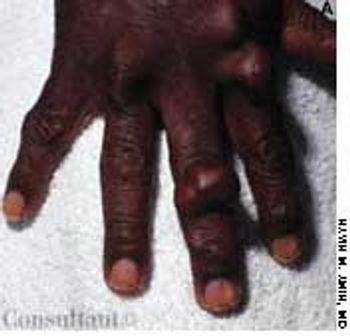
A 56-year-old man was admitted to the hospital with right lower lobe pneumonia, which was exacerbated by smoking-induced chronic obstructive pulmonary disease (COPD).
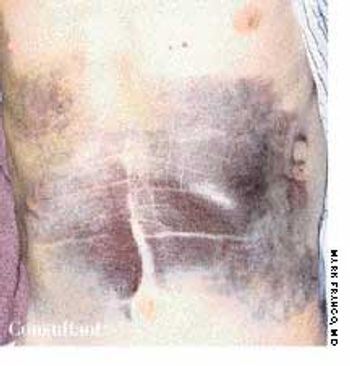
An 80-year-old man with a history of congestive heart failure, coronary artery disease, cardiomyopathy, and thoracic and abdominal aneurysms was taken to the emergency department because of mental status changes, back pain, and ecchymotic areas over his body. The ecchymoses started on his back 5 days before admission and spread to his abdomen.
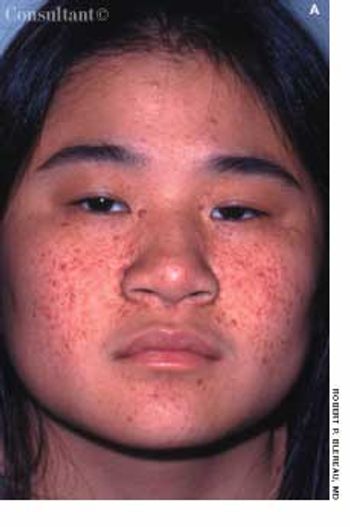
Tan-pink acneiform lesions on the face of a 15-year-old girl had not responded to topical acne therapy. A 1 × 0.5-cm, elevated subcutaneous nodule was noted on the right lateral knee. The lesions on her face and knee had been present for 11 years. The family history was noncontributory.
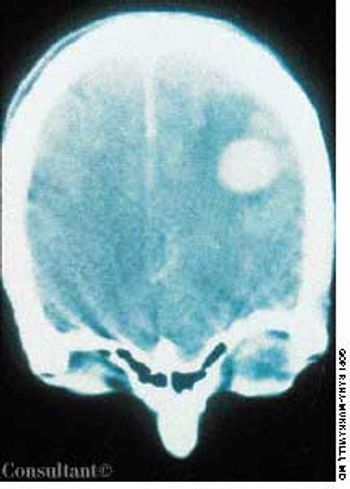
A 32-year-old man who had HIV disease complained of headache, fever, and weakness on his right side. His history included intravenous drug use, Pneumocystis carinii pneumonia, and mucocutaneous candidiasis.
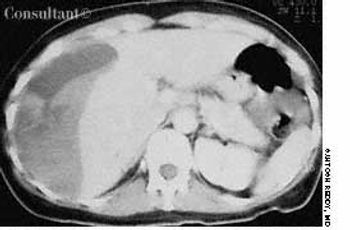
Intermittent right upper quadrant abdominal pain prompted a 42-year-old woman to seek medical consultation. Ultrasonographic examination of the abdomen revealed cholelithiasis; percutaneous gallstone dissolution was performed.
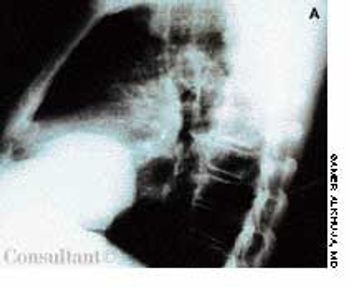
During the assessment of an 83-year-old man who had an infected arteriovenous graft, chest films showed a masslike density in the lower right hemithorax.
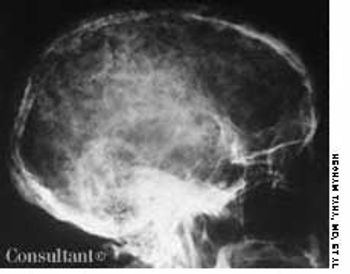
A 28-year-old woman reported that she was in good health before experiencing generalized weakness; exhaustion; and pain in her legs, shoulders, and back for the past 3 months. She also complained of shortness of breath with minimal activity, irregular menstrual periods, and occasional episodes of nose and gum bleeding.

An obese 56-year-old woman was hospitalized after 2 days of chest pain, shortness of breath, and palpitations. Physical examination revealed no abnormalities, and serial cardiac enzyme studies and an ECG ruled out myocardial infarction. However, transesophageal echocardiography showed a lesion in the mediastinum.
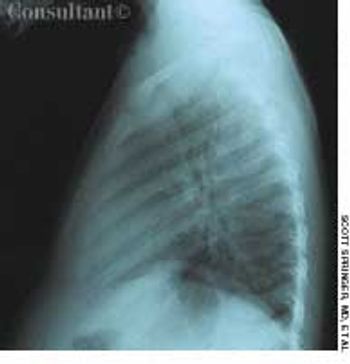
The parents of a 2-year-old boy with a 3-day history of fever took him to the emergency department. The child's temperature fluctuated between 38°C (100.4°F) and 39°C (102.2°F). As part of the workup, chest films were taken.