All News

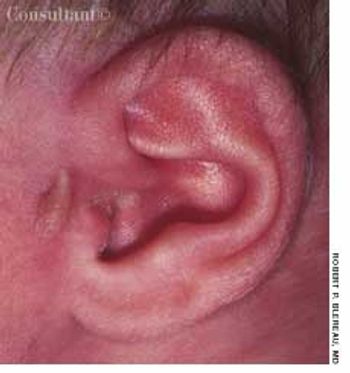
The left ear of a 1-month-old infant girl shows a congenital papillomatous lesion at the preauricular area. She had no other apparent abnormalities.

Dupuytren's Contracture

This contorted hand of a 49-year-old man demonstrates Dupuytren's contracture, a disorder first described by Baron Guillaume Dupuytren in 1831. Although the condition may occur as a completely independent abnormality, it is commonly associated with chronic liver disease, diabetes mellitus, epilepsy, palmar fasciitis, carpal tunnel syndrome, rheumatoid arthritis, pulmonary tuberculosis, and alcoholism. This patient had a history of alcohol abuse.

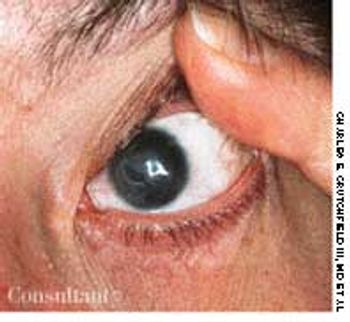
The use of preserved artificial tears several times a day provided little relief to this 54-year-old woman with red and painful eyes. The patient had a history of rheumatoid arthritis and dry eye syndrome; the latter is very common in patients with rheumatoid arthritis.

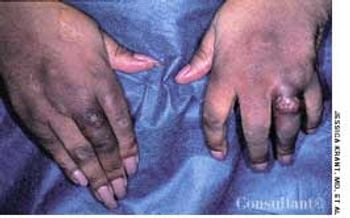
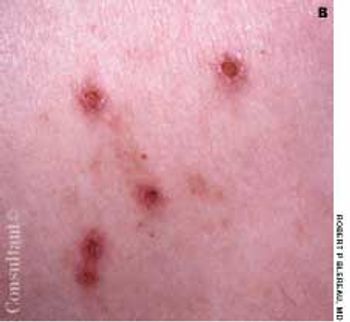
A 65-year-old woman, who was confined to a wheelchair because of severe rheumatoid arthritis, was concerned about nodules that had erupted on her fingers and hands during the previous 3 weeks. Her medical history included colon cancer, chronic renal insufficiency, anemia, and hypertension. The nonpruritic nodules were painful when they began to form under the skin; however, once they erupted, the pain disappeared.

Systemic Lupus Erythematosus

A variety of rheumatic diseases-systemic lupus erythematosus (SLE), rheumatoid arthritis (RA), and the vasculitides among them-manifest as “lumps, bumps, and holes” involving the extremities. Each of these diseases works through specific mechanisms on different structures of the skin to produce a distinctive pathology. In doing so, each provides clues to the cause, which the history and physical examination can help confirm.

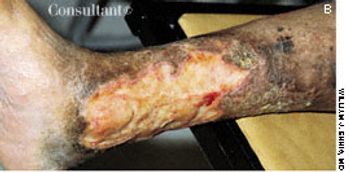
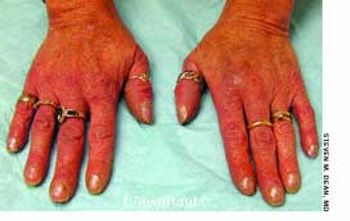
This 64-year-old woman has had rheumatoid arthritis for 15 years; her hands show classic rheumatic changes. She also had a leg ulcer that had failed to heal in 8 years despite three skin grafts.

Various types of cutaneous lesions may occur in association with RA, including rheumatoid nodules, rheumatoid neutrophilic dermatitis, vasculitis, palpable purpura, and pyoderma gangrenosum. Many of these manifestations-including rheumatoid nodules-are specific for RA. The presence of these nodules is associated with seropositive disease and with a more severe, erosive clinical presentation. The nodules appear in 20% to 30% of patients with RA. Sites of predilection are those subject to shear stress, including the subcutaneous tissues over the extensor aspects of the elbow region, over the sacrum in bedridden persons, and at the pericardial and pleural surfaces.

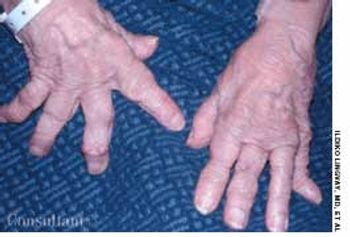
This 60-year-old man has had rheumatoid arthritis (RA) for 40 years. Typical of progressive, long-standing disease is the deformity seen here in his hands and feet.

Cutaneous and subcutaneous lesions of the extremities may be clues to the presence of rheumatic diseases such as systemic lupus erythematosus (SLE), rheumatoid arthritis (RA), and the vasculitides. The history and physical examination can generally help confirm the cause. Skin biopsy is sometimes necessary for a definitive diagnosis; useful results depend on a technique that gives the depth necessary to see the pathology and proper interpretation of biopsy specimens by an experienced dermatopathologist.

This 20-month-old girl was born to a 28-year-old mother at 38 weeks' gestation. The pregnancy was uncomplicated, and vaginal delivery was normal. The infant sat with support at 10 months of age, sat without support at 12 months, crawled at 13 months, and walked at 18 months. She had not yet begun to talk at 20 months. The child was noted to have frequent laughing episodes and often made flapping movements with her hands.

Anorexia Nervosa

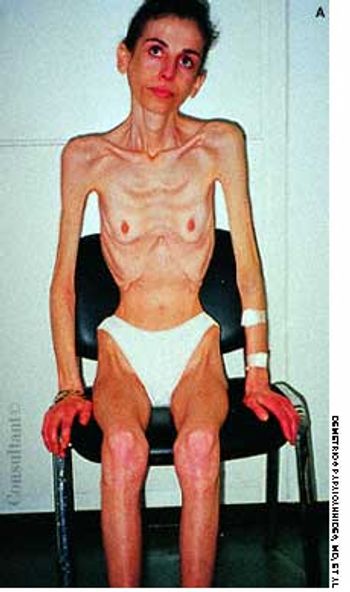
A 30-year-old woman was brought to the hospital with syncope, bradycardia, and hypotension. For the past 6 years, she had vomited after eating meals and after occasional episodes of binge eating.

Severely limited vision plagues this 27-year-old woman with aniridia, the bilateral absence of the iris of the eye.

Acute Renal Osteodystrophy

This x-ray film of a man in his 50s illustrates an extreme case of renal osteodystrophy. On examination, the patient's legs were very tender and one could actually see the femur bend in the examiner's hands as if it had a greenstick fracture.

Evaluation of intermittently discolored, cold fingers was sought by a 39-year-old woman with long-standing anorexia nervosa. The patient had never smoked and was not taking any vasoconstrictive drugs.

Adenoma of the Parotid Gland

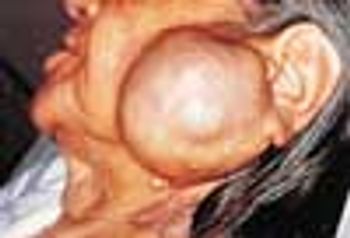
An 83-year-old woman-who had not visited a physician for 20 years-presented to the emergency department with a 1-day history of urinary retention and a 1-month history of gross vaginal bleeding. The mass on the left side of her face was a secondary finding.

Acute Appendicitis

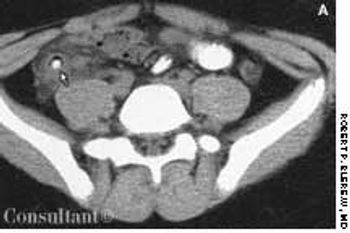
A 15-year-old boy presented with sharp, right lower quadrant abdominal pain, nausea, vomiting, and fever of 2 days' duration. His white blood cell count was 15,000/mL with a shift to the left on the differential. Right lower quadrant rebound tenderness was noted.