All News

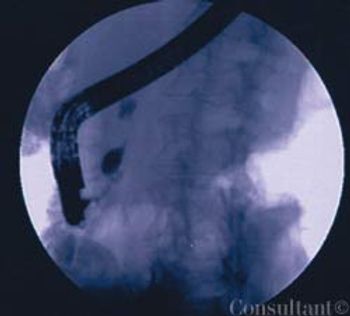
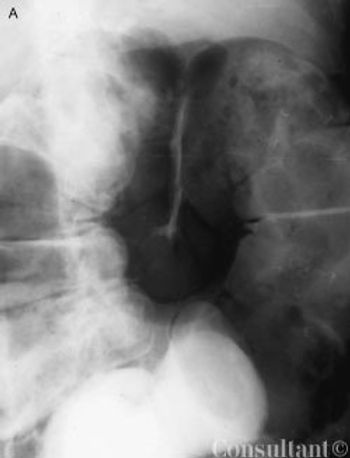
Progressive abdominal distention, nausea, constipation, and mild abdominal pain developed in an 82-year-old woman 5 days after she underwent surgical repair of a left hip fracture. Her medical history was significant for Parkinson disease, type 2 diabetes mellitus, and hypertension.
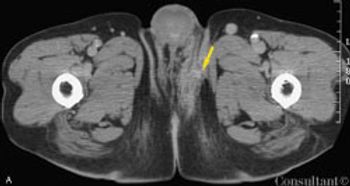

A 77-year-old African American man with type 2 diabetes mellitus and coronary artery disease presented to the emergency department with acute scrotal swelling and pain. His testicles were erythematous with focal areas of necrosis and associated tissue destruction. Similar skin changes were apparent in the lower abdominal and inguinal regions.

A 45-year-old woman presents with multiple injuries she sustained during a skiingaccident. She has fractures of her right arm and 3 ribs, as well as numerouscontusions. An abdominal CT scan shows no hemorrhage or other traumarelatedfindings; however, a 6.7-cm left adrenal mass is detected.

A 29-year-old man presents with right ankle paincaused by a basketball injury he sustained 1 day earlier.He fell after he had jumped up and landed on anotherplayer’s foot. The patient’s foot was “turned in” during thefall; this position indicates an inversion injury. He says hehas injured his ankle before but never this severely. Therest of the medical history is noncontributory.

A 63-year-old woman presents withdiffuse hyperkeratosis of the solesand palms. She also has onycholysis-separation of the nail plate fromthe nail bed-and salmon-coloredplaques behind her ears. Biopsy ofone of the plaques confirms the suspecteddiagnosis of psoriasis.

A middle-aged man with"jock itch" that has failed torespond to antifungal creams.An older woman who has diffusehyperkeratosis of predominantlyweight-bearing surfaces.A young man with mildlypruritic, small, salmon pinkpapules and thick white scaleon his trunk and arms.

A 30-year-old man presents with scalingand erythema of the scalp that extendspast the anterior hairline. Thepatient has a family history of psoriasis.For the past 5 years, he has experiencedwintertime flares of the diseasethat affect his scalp and the extensorsurfaces of the extremities.

A 46-year-old man complains that his"jock itch" failed to respond to antifungalcreams. The patient has hadpsoriasis on his elbows and knees formany years.

A 72-year-old man presents with skinlesions and nail abnormalities. Erythematous,sharply defined, demarcatedpapules and rounded plaquescovered by silvery micaceous scaleare noted on the elbows, knees, andscalp. Involved areas appear to be bilaterallysymmetric. Localized psoriasisvulgaris is diagnosed.

4A:Small, slightly pruritic, salmonpink papules with thick white scalehave arisen over the past 5 days onthe trunk and arms of a 24-year-oldman. The patient has a history ofvery mild psoriasis vulgaris of the elbows,knees, and scalp; he deniesstreptococcal pharyngitis or other recentinfections. Guttate psoriasis isdiagnosed.

Focal, painless discoloration of theleft thumbnail (A) developed severalyears earlier in this 46-year-old man.Oral antifungal therapy had no effecton the lesion.

A 35-year-old man presents with extensiveplaques over much of thetrunk and extremities. This severeflare of psoriasis developed after astressful emotional experience.

A 60-year-old man with a long historyof psoriasis vulgaris required a systemiccorticosteroid for a severe exacerbationof asthma. Soon after theErythrodermic or Pustular Psoriasiscorticosteroid was discontinued, generalizederythema and scaling of theskin developed.

Hyponatremia:

ABSTRACT: Correction of chronic hyponatremia is associated with a very high risk of CNS complications; avoid a rapid increase in serum sodium concentration if you suspect a patient's condition is chronic. Thiazide- or metolazone-induced hyponatremia can develop rapidly-in 1 to 2 weeks-and its only presenting signs may be fatigue and listlessness. Diuretic-induced hyponatremia is 4 times as common in women as in men. Various factors greatly increase the risk of acute hyponatremia after surgery. Hyponatremia that develops after an operation which involves irrigation with a solution of glycine, mannitol, or sorbitol (such as transurethral prostatectomy [TURP] or hysteroscopy) may be hypertonic. An osmolar gap greater than 15 is a clue to this condition. Treatment of hypertonic hyponatremia in post-TURP or posthysteroscopy syndrome may require dialysis and a nephrology consult.

A 43-year-old woman was admitted to the hospital withleft flank pain. The physical examination revealed a left abdominalmass. Laboratory test results identified normochromic-normocytic anemia (hematocrit, 33%; hemoglobin,10.8 g/dL; and mean corpuscular volume, 88 fL) andmicroscopic hematuria (10 red blood cells per high-powerfield).

Penile Cancer

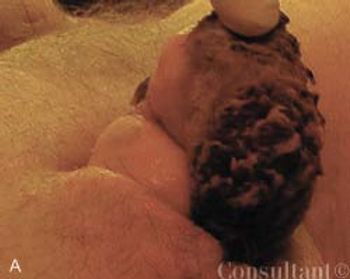
A 38-year-old man presented with a fleshy lesion beneath the tip of his penis. He had discovered it about 18 months before the initial evaluation. A second similar lesion resembling a “cauliflower” had appeared several weeks after the first. Both lesions had grown and had begun to bleed during intercourse.

Malignant Melanoma

A previously asymptomatic, largeblack plaque on a 65-year-old man’sscalp recently began to bleed. The lesionhad grown considerably since itfirst appeared as