





















































































































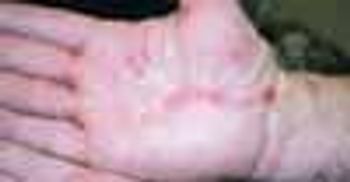
This painful, eroded plaque on thedorsum of a 39-year-old man’s handhad developed over a few days from asmall, painful pustule. The patient’shistory included ulcerative colitis,which was not active when the lesionoccurred.

This painful, eroded plaque on thedorsum of a 39-year-old man’s handhad developed over a few days from asmall, painful pustule. The patient’shistory included ulcerative colitis,which was not active when the lesionoccurred.

The pyoderma gangrenosum on theright anterior tibial area of a 40-yearoldman was thought to be associatedwith his rheumatoid arthritis. However,the cause of many of these ulcersis unknown. The patient could not recallany recent trauma. At least half ofall pyoderma gangrenosum lesionsoccur in persons who do not have associateddiseases.1

A tiny papule that arose after minortrauma to her finger marked theonset of this lesion, according to the48-year-old patient. She reports thatthe papule rapidly evolved into apustule that grew within 2 weeks intoa painful, undermined, purple-edgedulcer. The lesion did not respond toantibiotic therapy. The patient had rheumatoid arthritis.

Pyoderma gangrenosum is frequentlyassociated with systemic diseases,such as ulcerative colitis and Crohn’sdisease (Table). The occurrence of theskin ulcers does not necessarily correlatewith the activity of the underlyingdisorder.

A 57-year-old man was referred forevaluation of an enlarging, painful,irregular ulceration on his lower abdominalwall. The patient recalledhaving a small, red, “blister-like” lesionthat had rapidly expanded to itscurrent size of 2.5 * 4.5 cm. Hedenied specific injury to the skin;however, he often wore jeans thatrubbed the area. The patient wastaking ibuprofen for seropositiverheumatoid arthritis.

A disorder similar to scleromyxedema, nephrogenic fibrosing dermatopathy, has been reported in patients receiving renal dialysis. Lichen myxedematosus, an atypical form of papular mucinosis, is not associated with sclerosis and paraproteinemia; however, it may represent an early presentation of scleromyxedema.

Which of the rashes pictured here is tinea corporis?

A spreading pruritic rash, an eruption of vesicles, an intermittently pruritic lesion--can you identify the disorders pictured here?

These patients have chronic paronychia. This inflammatory nail bed disorder is usually caused by prolonged exposure to wet environments and repeated minor cuticle trauma. Christopher Montoya, PA-C, of Beaverton, Ore, and Timothy R. Hurtado, DO, of Yongson, Korea, report that the nails of a 33-year-old man's right index finger and ring finger displayed multiple lateral grooves and edema near the eponychium.

A 47-year-old woman who wasseropositive for HIV-1 presented tothe emergency department with severemaculopapular, erythematouseruptions. Her antiviral regimen hadrecently been changed from zidovudine,300 mg bid; lamivudine, 150 mgbid; and saquinavir, 600 mg tid, tolamivudine, 150 mg bid; stavudine, 40mg bid; and nevirapine, 200 mg/d.

I suspect that my patient has hereditary angioedema (HAE). During her lastpregnancy 2 years earlier, she had severe preeclampsia.

The patient might havebeen exhibiting a phenomenon sometimes seen in methamphetamine users that isreferred to as "crank bug bites." Patients claim to see and/or feel bugs on theirbody and attempt to remove them or pick at them until they create open woundsand scabs.

A 34-year-old woman awoke with apainful, crusted ulcer on her upperarm. She has been repairing dry wallin her home but recalls no trauma.The necrotic ulcer features an erythematousborder.

Nongenital cutaneous warts--that is, common, plantar, filiform, and flat warts--are manifestations of the human papillomavirus (HPV). These warts are among the most common dermatologic complaints seen in primary care practices and are among the most common lesions treated by dermatologists.

A nonhealing ulcer recently developedin a painful facial rash that hadworsened over several months. The44-year-old patient is a heavy drinkerwith a history of elevated liver functionlevels. She has had numerousunprotected sexual contacts over theyears.

The last naturally occurringcase of smallpox was reportedin Somalia in October 1977.Despite the eradication ofsmallpox, the causative agent,variola virus, remains in existence.1,2

A pruritic facial eruption; asymptomatic, erythematous lesions;a persistent papule--can you identify the disorders pictured here?

A 5-year-old boy, who lives on a farm and routinely plays with his pet dogs, presented with these scaly, inflamed macules with a central clearingon the abdomen and forehead.

An 11-year-old boy who was receiving continuous ambulatory peritoneal dialysis because of end-stage renal disease secondary to membranoproliferative glomerulonephritis was hospitalized with hypocalcemia 2 days after subtotal parathyroidectomy. Before the surgery, multiple lesions were noted on the child's thighs (shown here), upper arms, and abdomen. The lesions, some with calcium deposits, were hard and painful. A biopsy of the lesions revealed histologic findings consistent with cutaneous calcinosis.

A simple trick for preventing recurrence of an ingrown toenail.

With the onset of winter, dry and scaly skin accompanied by pruritus prompted this patient to seek medical attention.

I am concerned about Dr Benjamin Barankin's recent "Photoclinic" case of an alleged brown recluse spider bite.

Erythematous patches and papules on the knuckles; a slowly enlarging papule on a finger; a painful ulcer on the thumb; rough, thickened skin around the metacarpophalangeal joints; symmetric, soft, tan papules....

Generalized weakness and malaise have bothered a 44-year-old woman for a few days. The patient has several large, flat facial lesions that have been present for years; she has never consulted a physician about them.

An asymptomatic acneiform eruption; persistent, mildly pruritic papules; a pustular rash that resists antibiotics--can you identify the disorders pictured here?