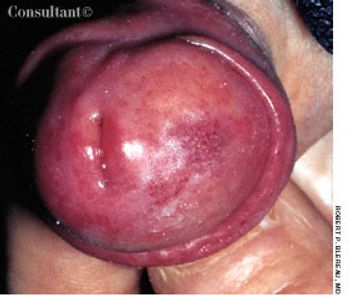
A 78-year-old man presented with an asymptomatic, irregular lesion on the right side of the glans penis. The 0.5-cm, light purple injected, finely papular lesion had spontaneously erupted about 2 months earlier.

A 78-year-old man presented with an asymptomatic, irregular lesion on the right side of the glans penis. The 0.5-cm, light purple injected, finely papular lesion had spontaneously erupted about 2 months earlier.

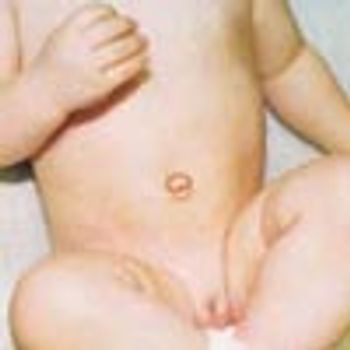
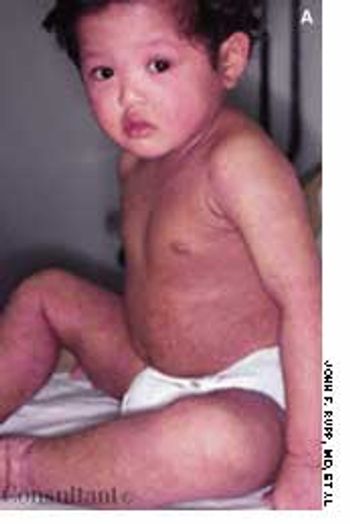
The onset of atopic dermatitis can be seen in infants who have a family history of inhalant allergies, (eg, seasonal allergy, allergic rhinitis, or allergy-induced asthma). The cheeks and large flexural folds of affected children are erythematous and scaly. Involved areas of the trunk and extremities may exhibit discrete patches or a generalized rash.

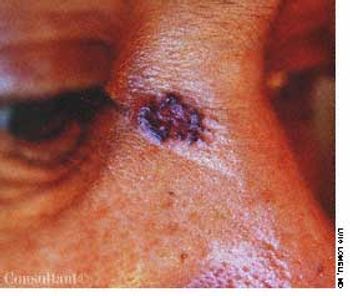
When this lesion was seen on the face of a 54-year-old farm worker, cutaneous melanoma was the immediate concern. Accordingly, a full-thickness excisional biopsy was performed. (Curettage and shave biopsy are contraindicated for a suspected melanoma.)

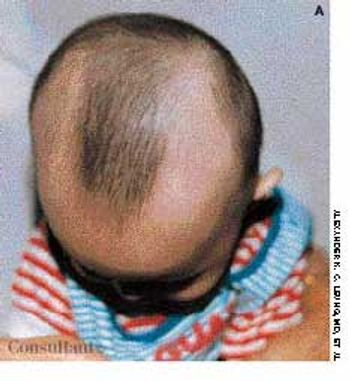
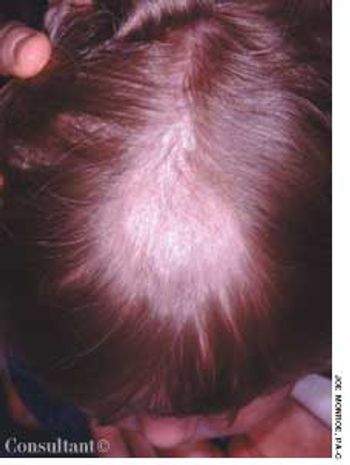
Many disorders that scar the skin also affect the scalp. Systemic lupus erythematosus, when associated with high fever and extensive systemic involvement, can cause a diffuse anagen effluvium. Hair loss caused by localized discoid lupus erythematosus (DLE) is more common. DLE may affect the scalp, where it is seen as circumscribed areas of often irreversible hair loss.

Numerous plaques, some with yellow crusting and central scarring, had erupted primarily on the face and neck of a 46-year-old man. A single lesion had developed on his left elbow as well. The lesions were initially diagnosed as impetigo, but they failed to resolve after 2 courses of oral cephalexin.

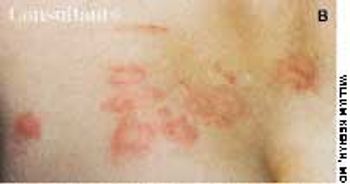
Disturbed by a pruritic rash of 5 days' duration on his chest, neck, and back, a 35-year-old man sought medical advice. The patient had no other symptoms.

For years, a 39-year-old man had an eruption on his hand, which seemed to be controlled with topical corticosteroids. The patient was a rancher.

The parents of a 12-year-old sought a consultation for the “cyst” that had appeared on their daughter's lower back. The lesion was first noticed 2 months earlier upon the child's return from a trip to Belize.

An 8-year-old boy was taken to his physician because of a rash around his mouth. After spending the day at the beach with his family, his lips had become red, itchy, and swollen. His sister had a similar, although milder, condition. Both children had been sucking on limes while at the beach. One week later, the boy experienced the chapped lips, patchy perioral erythema, swelling, and blisters.

Benign skin tumors seen in pregnant patients as well as those who are not pregnant include acrochordons, seborrheic keratoses, pyogenic granulomas, and spider angiomas. There have been reports that melanocytic nevi develop or change during pregnancy; however, a pilot study at our institution was unable to confirm this finding.

A 58-year-old black woman sought evaluation of areas of increased pigmentation on her cheeks that had been present for many years. Bleaching agents did not lighten the area; new, non–nickel-containing eyeglass frames had no effect. A 3-week course of halobetasol cream failed to fade the hyperpigmentation.

A 30-year-old anesthesiologist complained of 5 days of pain in the left epitrochlear and axillary regions. A large, tender node was palpable in each site.

A 63-year-old man was given oral celecoxib, 100 mg bid, for shoulder pain. Three days later, a pruritic rash appeared on his back, then spread to the chest, lower legs, and face. He stopped the celecoxib on his own and self-administered diphenhydramine for the pruritus. The rash and itch persisted, which prompted the patient to seek medical care. He had no respiratory symptoms.

A 32-year-old man presented with a yellow, papular rash on the buttocks and extensor surfaces. His medical history included diabetes mellitus, alcoholism, obesity, and polysubstance abuse. Laboratory results disclosed a serum triglyceride level of 5,793 mg/dL.

A 62-year-old woman presented with an itchy, annular eruption on her face of 3 months' duration. A topical antifungal was prescribed, but the slow response to therapy prompted a switch to a topical corticosteroid (triamcinolone 0.1%). The lesion not only failed to clear but became larger.

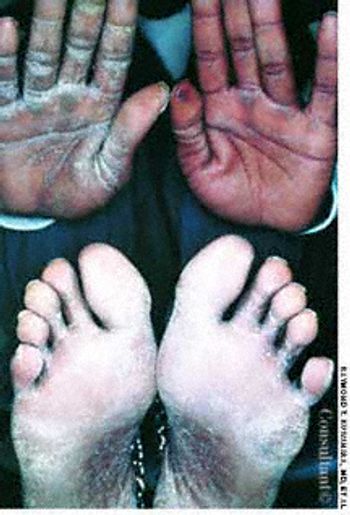
For about 4 months, a very dry, diffuse, fine scaly, asymptomatic eruption covered the palms of a 28-year-old man; several fingernails were dystrophic bilaterally as well. Before the onset of this condition, bilateral onychomycosis of the toenails had been diagnosed.

Low-potency corticosteroids had not resolved a rash of several month's duration on the buttocks of a 2-year-old girl.

A 6-year-old girl with mental retardation was seen for a physical examination. She was being followed by a neurologist for seizures that began in her first year of life. She had no acute health problems.

Consultation was sought for diagnosis of the concentric rings of erythema and scaling that appeared on one side of a 42-year-old woman's face. The patient had used a moderately potent topical corticosteroid that had been prescribed for a facial "rash."

Several hours after returning from a walk in tall grass, a 9-year-old boy began to complain about intense itching around his waist, lower back, and upper arms. Wheals developed on these areas.

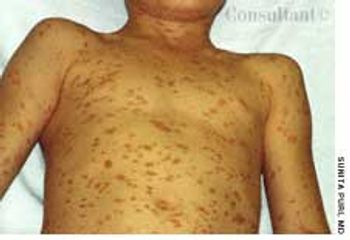
For 2 months, an asymptomatic rash had been present on the upper arms of a 16-year-old boy of normal weight. The rash, as seen on the patient's right arm, consisted of abundant fine papules. He had no other lesions.

Each spring for the past 3 years, this boy has complained of an itchy ear rash. The dull red edematous papules develop on the outer portion of the helix, and the rash heals promptly after 2 weeks.

This asymptomatic pigmented lesion on the left posterior jaw of a 52-year-old man had been present for 6 years, with no evidence of recent change. At the patient's request, the lesion was excised.

HIV infection was diagnosed in a 34-year-old man 3 years before he was hospitalized. The patient had a 2-week history of nausea; vomiting; and diffuse, intermittent, poorly localized abdominal pain. He had received radiotherapy and chemotherapy for Kaposi's sarcoma (KS) of the upper and lower extremities, which had been diagnosed 8 months earlier.

A male infant was born to a 29-year-old woman (gravida 3, para 2), following an uncomplicated pregnancy and normal vaginal delivery. At birth, a brownish 1-cm nodule was noted on the right side of the upper abdomen. The infant was otherwise healthy.