

















































































































































Dermatology

Latest News


CME Content


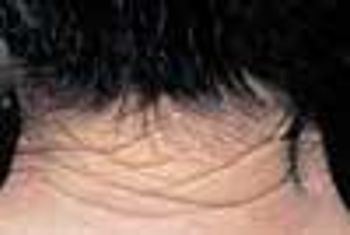
During a routine skin cancer screening, yellowed, thickened, leathery skin was noted on the posterior neck of a 73-year-old retired construction worker. Colloquially, this condition is called “sailor's skin” or “farmer's skin” and is seen in persons who have had long-term exposure to the sun. It is known clinically as cutis rhomboidalis nuchae, because the well-defined furrows in the skin resemble an irregular rhomboidal pattern.

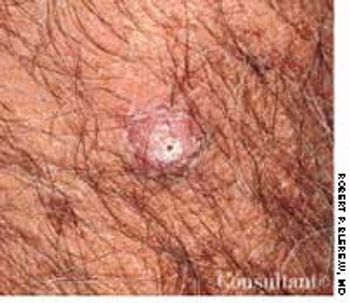
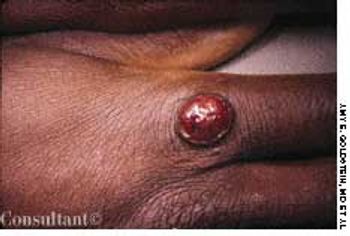
A 32-year-old man who had no significant medical history complained of “something growing on the knuckles of my right hand.” He reported that a “bump” was forming on the site of a cut he sustained while slaughtering sheep 3 weeks earlier. There was no blister, discharge, or pain. The patient denied any fever, cough, or malaise. He also did not recall seeing any lesions or “bumps” on the sheep.

A 40-year-old dental assistant requested a prescription for antibiotics to treat the acute outbreak of painful, deep blisters that had recurred on her index finger. Prior eruptions of similar lesions had been diagnosed as staphylococcal infections and were treated with antibiotics.

Morphea

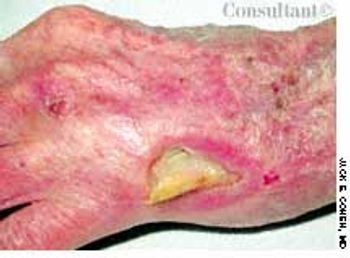
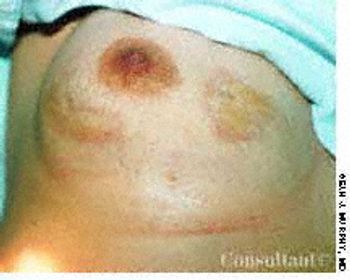
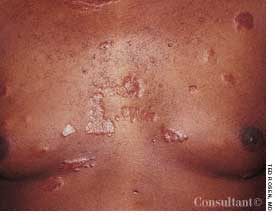
Two enlarging, dry, tender lesions had developed on the right breast of a 62-year-old woman 2 years before she sought medical consultation. The patient had no other symptoms; she was taking metoprolol succinate for cardiac arrhythmias.

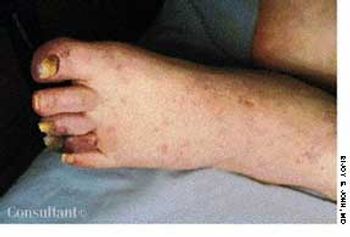
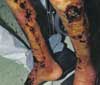
A 65-year-old man presented with bluish toes and petechiae on his toes and feet 3 days after having undergone renal angiography. Bilateral pitting pedal edema was noted, and laboratory tests revealed proteinuria, eosinophilia, and an erythrocyte sedimentation rate (ESR) of 65 mm/h.

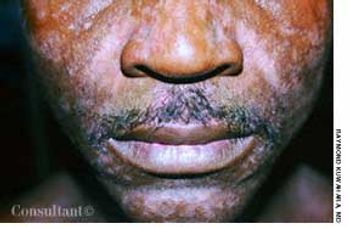
This 27-year-old man complained that a facial rash of several years' duration had worsened during the past few months. Hypopigmented macules with scale were especially prominent on the eyebrows and in the nasolabial folds; a moderate amount of scale was noted on the scalp. The patient was seropositive for HIV.

A 56-year-old man was admitted to the hospital with right lower lobe pneumonia, which was exacerbated by smoking-induced chronic obstructive pulmonary disease (COPD).

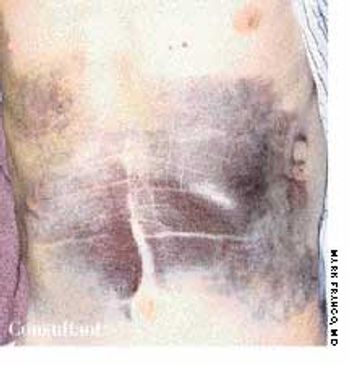
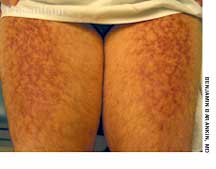
An 80-year-old man with a history of congestive heart failure, coronary artery disease, cardiomyopathy, and thoracic and abdominal aneurysms was taken to the emergency department because of mental status changes, back pain, and ecchymotic areas over his body. The ecchymoses started on his back 5 days before admission and spread to his abdomen.

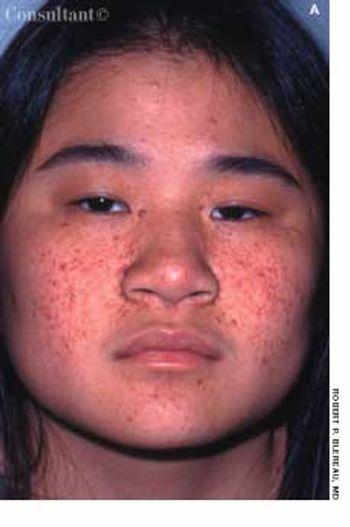
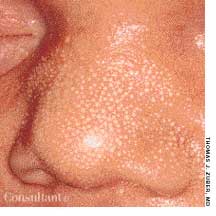
Tan-pink acneiform lesions on the face of a 15-year-old girl had not responded to topical acne therapy. A 1 × 0.5-cm, elevated subcutaneous nodule was noted on the right lateral knee. The lesions on her face and knee had been present for 11 years. The family history was noncontributory.

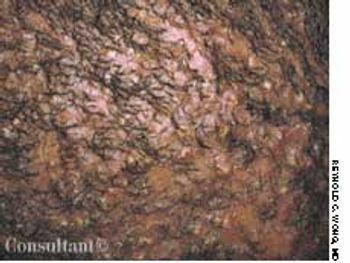
A 35-year-old man had a 5-year history of progressive hair loss characterized by follicular inflammation with destruction of the follicle and consequent permanent alopecia. Almost the entire scalp was involved. A few pustules were seen on examination, but the clinical picture was mostly one of scarring and irreversible hair loss.

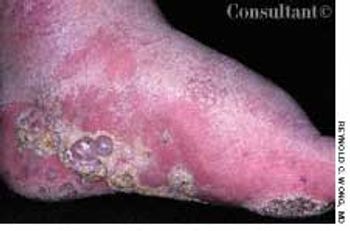
A 79-year-old nursing home resident was hospitalized for evaluation of hyperkalemia and leukocytosis. Her medical history included hypertension, respiratory failure with subsequent tracheostomy placement and ventilator dependency, and anemia. Both of her legs had been amputated above the knee secondary to complications of type 2 diabetes mellitus.

After 3 months of seeing this painless mass at the angle of the 3-year-old's left jaw, his parents sought medical advice for their son. The youngster had no constitutional symptoms. A Mantoux test was performed, and an erythematous, indurated area measuring 15 mm in diameter was found at the test site 48 hours later.

The pigmented hairy nevus that covers the entire right upper arm of this 18-month-old boy has been present since birth. More than 95% of large, congenital pigmented nevi have a hairy component.

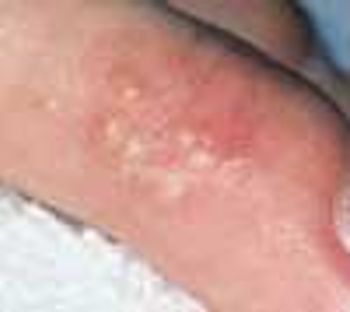
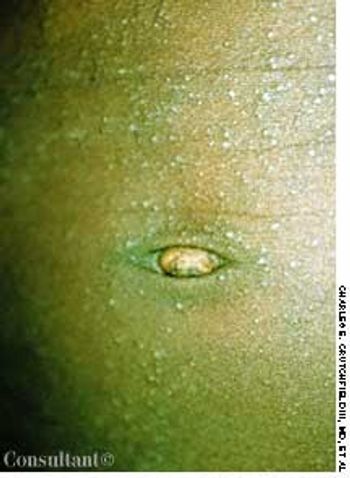
This erythematous, papulovesicular eruption developed in a hospitalized patient who had a febrile illness that was accompanied by drenching sweats. Miliaria rubra, or prickly heat, is caused by sweat trapped in obstructed eccrine glands of the epidermis. Inflammation, irritation, and pruritus can occur along with the rash.