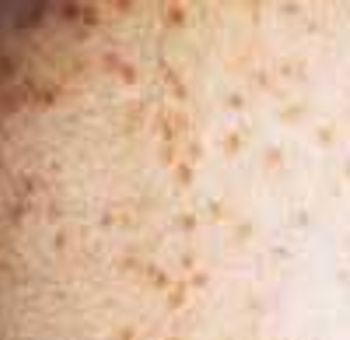































































































































A 28-year-old white man presented with a recent-onset rash that involved the upper arms.


A 28-year-old white man presented with a recent-onset rash that involved the upper arms.

A 25-year-old black man was intermittently plagued with a mildly pruritic eruption on his chest and back only.

A 37-year-old black man was referred for dermatologic consultation pertaining to a pending legal proceeding.

A 16-year-old high school wrestler developed an acute, pruritic eruption involving both arms and a small portion of the chest.

A recently married 24-year-old black man was brought (reluctantly) by his wife for consultation regarding the perpetual "dirt" on his back.

A 16-year-old black girl complained of a gradually worsening facial eruption. She had been assured by her family physician that this was caused by an allergy to soap; she applied over-the-counter 1% hydrocortisone cream daily.

An intensely itchy dermatosis developed on the back of a 30-year-old Saudi Arabian renal transplant patient. The patient had never before experienced a similar eruption. He was taking prednisone and azathioprine to prevent transplant organ rejection, as well as amoxicillin for an upper respiratory tract infection.

A hyperpigmented macule on the submental surface disturbed this 56-year-old man.

A 54-year-old Asian woman complained of itching from a newly erupted rash.

Painful, erythematous plaques had erupted 4 to 6 weeks earlier on the left upper arm and lower abdominal wall of a 54-year-old woman.

A 46-year-old woman with type 1 diabetes mellitus presented to the emergency department with wheals, flares, and severe pruritus of her face and trunk.

A 25-year-old man presented with an erythematous, pruritic, scaly, macular rash that had begun behind his ears and spread over his neck, chest, trunk, and upper and lower extremities.

This patient has a 2-year history of red plaque with a yellow atrophic center on the leg, which has ulcerated over the past 3 months.

These velvety, hyperpigmented plaques are secondary to acanthosis nigricans, a common problem in patients with insulin-resistant states.

Hundreds of yellow papules developed on the trunk and extremities of this patient, whose diabetes was uncontrolled.