HIV AIDS

Latest News


CME Content


African Kaposi Sarcoma

An 84-year-old Ethiopian woman presented with tender, violaceous, nonblanching nodules that had coalesced into plaques on the soles of both of her feet over the past 3 months. Similar discrete nodules were found on the dorsal aspect of her right wrist.

Classic Kaposi Sarcoma

For 1 month, a 66-year-old man had had an asymptomatic lesion on the dorsum of his left hand. The flesh-colored, dome-shaped, maroon-crusted lesion measured 0.7 cm and was located over the fourth knuckle. The patient had chronic obstructive pulmonary disease but was otherwise in good health. He was seronegative for HIV.

A 59-year-old woman presents with right-sided, nonradiating, “aching” chest pain that has been continuous and increasing in severity for the past 3 days. It began as a tightness that gradually became more painful; it is aggravated by palpation and movement and has not been relieved by acetaminophen.

A 46-year-old man with AIDS (CD4+ cell count, 150/μL) presented with a painful nodular lesion on the plantar surface of his right foot. The lesion had appeared 1 month earlier as a painless, 1-cm, raised, reddish purple nodule and had progressively enlarged to 5 cm. Six months earlier, the patient had cryosurgery to remove a similar, larger lesion on the posterior aspect of his right midcalf.

Over the past 4 decades, our understanding of the role of elevated cholesterol in cardiovascular disease (CVD) has undergone radical change. During that time, we have moved from a belief that cholesterol does not matter and that atherosclerosis is an irreversible process to a strong conviction that treating elevated cholesterol, especially elevated low-density lipoprotein cholesterol (LDL-C), can slow and perhaps halt the progression of atherosclerosis. But it has been a slow process for several reasons. In the 1960s, the Framingham investigators demonstrated that elevated serum cholesterol is a risk factor for CVD.1

Together the spondyloarthropathies form a group of overlapping chronic inflammatory rheumatologic diseases that show a predilection for involvement of the axial skeleton, entheses (bony insertions of = ligaments and tendons), and peripheral joints. They also may involve extraskeletal structures, especially the eyes, lungs, skin, and GI tract.

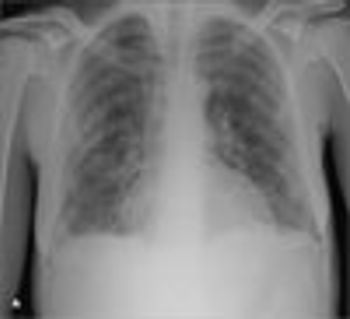
For 3 days, a 45-year-old woman with HIV infection who was noncompliant with her antiretroviral medications had cough, yellowish sputum, fever, and dyspnea. She denied hemoptysis, weight loss, or recent hospitalization. She had a long history of heavy smoking and alcohol and intravenous drug abuse.

Patients with newly diagnosed dyslipidemia often have difficulty remembering the difference between highdensity lipoprotein (HDL) and lowdensity lipoprotein (LDL) cholesterol.

An article in The New York Times succinctly summarized the World Health Organization's (WHO) recent report on the leading causes of death in the world: "As the world's population ages, gets richer, smokes more, eats more, and drives more, noncommunicable diseases will become bigger killers than infectious ones over the next 20 years."

A 55-year-old woman seen because of new lump under right side of her jaw; present for 24 hours. Associated neck discomfort causing dysphagia, and also a raspy turn to the voice; both much worse in last 12 hours. No dyspnea. No sore throat.

The numerous symptom domains of fibromyalgia syndrome (FMS) include pain, fatigue, sleep disturbance, mood disturbance, function impairment, irritable bowel syndrome, tension and migraine headache, and cognitive dysfunction. Its pathophysiology is rooted in neural dysregulation in the spinal cord and brain.

A 28-year-old woman presents with milky discharge in both breasts and throbbing occipital headaches of 4 months' duration. The headaches begin gradually, do not radiate, and have no apparent triggers or relieving factors.

The practice of academic detailing is gaining interest and momentum in some health care circles. The primary aim of academic detailing is to prevent the overuse and misuse of certain medications. This is done by educating prescribers on the therapies that are clinically appropriate as well as the costs of therapeutically similar choices. It is less an issue of switching to generics than it is of favoring step therapy or moving toward cost-effective therapeutically equivalent options. A well-designed program should maintain prescriber autonomy and quality of care while helping manage drug costs for both health plans and patients.

Last month I wrote about how patients-or rather consumers-were taking on greater responsibility for decisions affecting their own health, largely because of the Internet and the ability to research and form opinions about individual treatments. That was only scratching the surface of how the Internet is revolutionizing health care.

As more high-cost biologic drugs become part of standard care, the FDA has been under pressure to devise a way to allow generic versions of biologics to reach the market. Although competing industry interests have made it difficult for the agency and Congress to agree on such an approach, 2008 may be the year when that changes.

The differential diagnosis of generalized weakness is enormous; it includes disorders at all levels of the neur-axis. A variety of electrophysiological, pathological, radiographic, and other laboratory studies may be indicated depending on the specific diagnostic possibilities; costs can be controlled if such investigations are selected judiciously.