

Concern about this flat, tan, atrophic, well-marginated, dime-sized lesion prompted a 44-year-old woman to seek medical advice. The lesion, which was mildly pruritic, had appeared 2 months earlier.
Concern about this flat, tan, atrophic, well-marginated, dime-sized lesion prompted a 44-year-old woman to seek medical advice. The lesion, which was mildly pruritic, had appeared 2 months earlier.
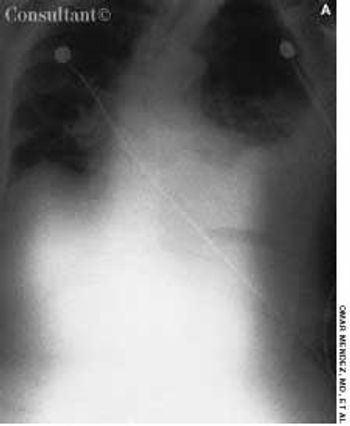
An 85-year-old white woman was brought to the emergency department (ED) with acute, severe left posterolateral chest wall pain of several hours' duration. The nonradiating pain was accompanied by shortness of breath. She denied palpitations, diaphoresis, syncope, or dizziness.
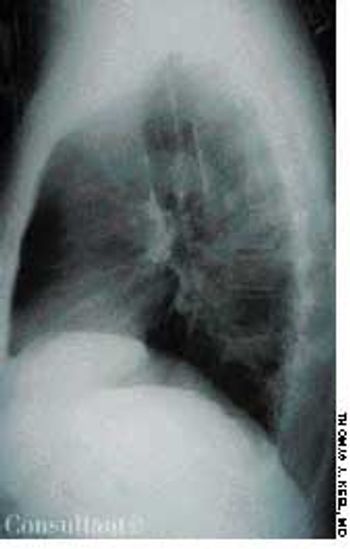
The wife of an 82-year-old man with Alzheimer's disease was concerned about her husband's poor posture. According to the woman, the patient had never sustained a back injury and had always maintained a sedentary lifestyle. He never smoked cigarettes and did not use alcohol. His history included multiple transient ischemic attacks (TIAs).

An area of mottled skin developed on the back of a 55-year-old woman who has had arthritis for several years. She often applied a heating pad to her middle and lower back for relief from arthritic pain.
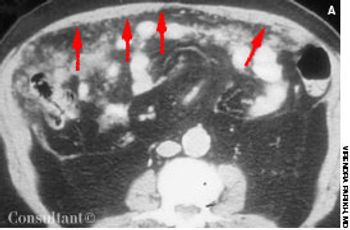
Vague abdominal pain, malaise, anorexia, and the loss of 10 lb in 2 months prompted a 65-year-old man to seek medical evaluation. A year earlier he had undergone surgery for stage III carcinoma of the sigmoid colon. Because metastases to the lymph nodes were found in the resected colon, the patient was given postoperative chemotherapy. Histologic examination revealed poorly differentiated adenocarcinoma.

Also known as congenital aganglionic megacolon, this condition is characterized by a congenital absence of ganglion cells in the submucosal (Meissner) plexus and the myenteric (Auerbach) plexus in one or more segments of the colon. This is attributable to a failure of migration of nerve cell elements from the neural crest in a cephalocaudal direction along the GI tract. The absence of parasympathetic innervation causes failure of relaxation of the internal anal sphincter. An aganglionic colon does not permit normal peristalsis to occur and thus results in a functional obstruction.
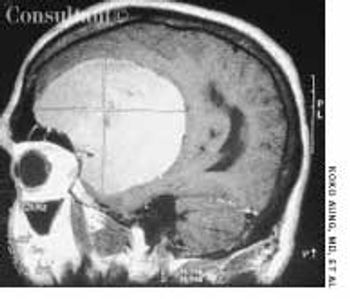
A 43-year-old man was admitted to the hospital with a 2-day history of nausea and vomiting. He vomited about 6 times each day. Cerebral palsy had been diagnosed in childhood; the patient used a wheelchair.

An infant born to a 25-year-old gravida 2 para 1 mother by cesarean section at 36 weeks' gestation had loops of small intestine protruding from the abdominal cavity.

For 1 month, a 66-year-old man had had an asymptomatic lesion on the dorsum of his left hand. The flesh-colored, dome-shaped, maroon-crusted lesion measured 0.7 cm in diameter and was located over the fourth knuckle. The patient had chronic obstructive pulmonary disease but was otherwise in good health. He was seronegative for HIV.

Rapid swelling and redness of a 13-month-old child's right upper eyelid prompted his parents to seek medical care for the infant. The parents reported that the child was slightly more fussy than usual and had no history of trauma.
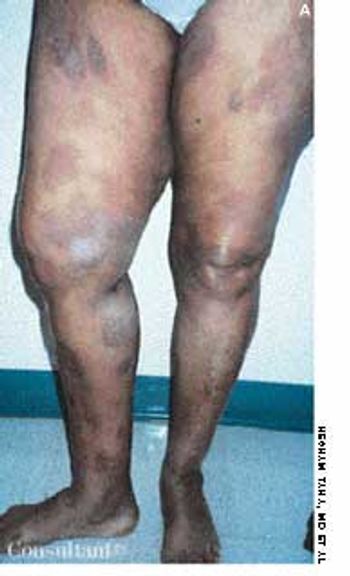
A 55-year-old woman with no significant medical history reported that diffuse erythematous, patchy, purpuric skin lesions over most of her body had been present for the past year. Applications of an over-the-counter corticosteroid cream helped control the pruritus but did not clear the skin lesions.
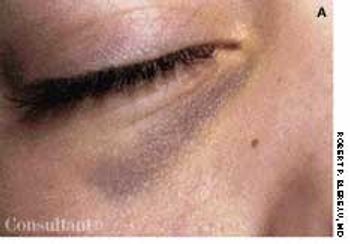
The mother of this 10-year-old boy noticed the shiner on her son's right eye after he awakened one morning. The child had bronchitis and a persistent cough for the past few days. Particularly alarmed by the extensive subconjunctival hemorrhage that appeared the next morning, the parent brought her child for medical evaluation. The youngster had no history of injury.

The bilateral breast hypertrophy seen on a 12-day-old boy's chest began 4 days earlier. This anomaly results from elevated levels of maternal circulating estrogen in late gestation that crosses the placenta and stimulates the baby's breasts. Both sexes are affected equally.
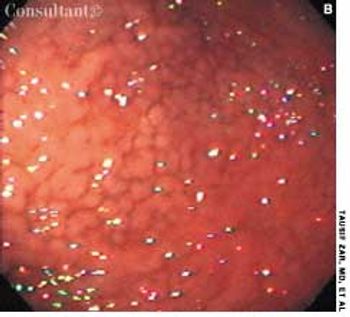
Persistent bloating, epigastric discomfort, and increased gastric acidity prompted a 47-year-old woman to seek medical care. Gastroesophageal reflux disease was diagnosed; antacids and H2-blockers were prescribed but provided no relief.

The parents of a 3-month-old infant sought medical advice because of a mass in the child's umbilical area. The mass increased in size when the infant cried, coughed, or strained and was reducible inside the abdomen by external pressure.
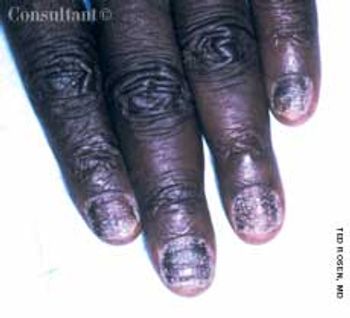
A 43-year-old man sought treatment of a “fungal nail infection” that had been present for several years. The condition had not responded to standard dosages of itraconazole, terbinafine, and fluconazole prescribed by another physician.
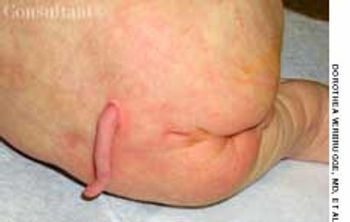
A 6-cm midline tail-like soft tissue appendage was noted on the back of this newborn infant at the level of L5. An epithelialized mid-sacrum dimple was also present inferior to the appendage. The infant otherwise appeared to be normally developed.

Endoscopic evaluation of a 61-year-old man hospitalized with a 4-month history of rectal bleeding, mucous discharge, and change in bowel habits revealed this large, sessile villous adenoma. The lesion occupied half the circumference of the bowel wall in the distal sigmoid colon, 25 cm from the anal verge. Examination of biopsy specimens showed benign villoglandular adenoma with atypia, with no invasive carcinoma. Sigmoid resection was carried out, and the patient recovered well.
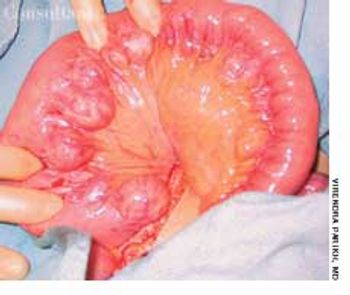
During routine exploration of the abdominal viscera before rectal carcinoma resection, diverticula were found in the jejunum of a 75-year-old woman. These outpouchings were located on the mesenteric side of the bowel. Because the patient was asymptomatic, no treatment was given. The rectal cancer was resected; her postoperative course was uneventful.

A 6-year-old boy presented with a mass on the left side of the scrotum. The mass did not vary in size and was asymptomatic; it transilluminated brightly. Physical examination showed it to be 4 × 2 cm. The spermatic cord could be felt above the mass. The left testis was impalpable separately.