
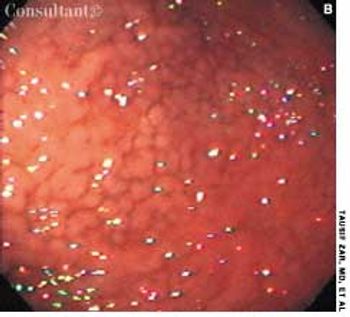
Persistent bloating, epigastric discomfort, and increased gastric acidity prompted a 47-year-old woman to seek medical care. Gastroesophageal reflux disease was diagnosed; antacids and H2-blockers were prescribed but provided no relief.
Persistent bloating, epigastric discomfort, and increased gastric acidity prompted a 47-year-old woman to seek medical care. Gastroesophageal reflux disease was diagnosed; antacids and H2-blockers were prescribed but provided no relief.

The parents of a 3-month-old infant sought medical advice because of a mass in the child's umbilical area. The mass increased in size when the infant cried, coughed, or strained and was reducible inside the abdomen by external pressure.
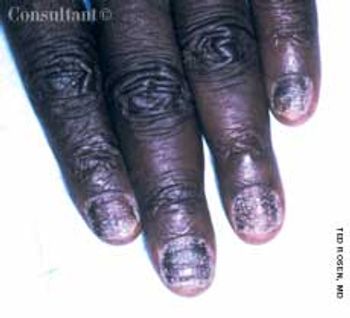
A 43-year-old man sought treatment of a “fungal nail infection” that had been present for several years. The condition had not responded to standard dosages of itraconazole, terbinafine, and fluconazole prescribed by another physician.
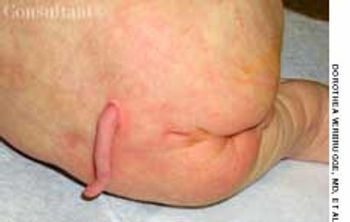
A 6-cm midline tail-like soft tissue appendage was noted on the back of this newborn infant at the level of L5. An epithelialized mid-sacrum dimple was also present inferior to the appendage. The infant otherwise appeared to be normally developed.

Endoscopic evaluation of a 61-year-old man hospitalized with a 4-month history of rectal bleeding, mucous discharge, and change in bowel habits revealed this large, sessile villous adenoma. The lesion occupied half the circumference of the bowel wall in the distal sigmoid colon, 25 cm from the anal verge. Examination of biopsy specimens showed benign villoglandular adenoma with atypia, with no invasive carcinoma. Sigmoid resection was carried out, and the patient recovered well.
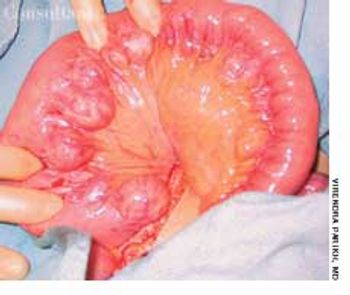
During routine exploration of the abdominal viscera before rectal carcinoma resection, diverticula were found in the jejunum of a 75-year-old woman. These outpouchings were located on the mesenteric side of the bowel. Because the patient was asymptomatic, no treatment was given. The rectal cancer was resected; her postoperative course was uneventful.

A 6-year-old boy presented with a mass on the left side of the scrotum. The mass did not vary in size and was asymptomatic; it transilluminated brightly. Physical examination showed it to be 4 × 2 cm. The spermatic cord could be felt above the mass. The left testis was impalpable separately.
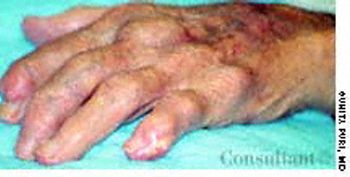
A 65-year-old man had a 10-year history of deformity of the hands, pain, and nodules on the fingers. His serum uric acid level was 9 mg/dL. The suspected diagnosis of chronic tophaceous gout was confirmed by the finding of birefringent monosodium urate needle-shaped crystals in the joint fluid and the patient's significant response to colchicine within 12 to 24 hours of the start of therapy.
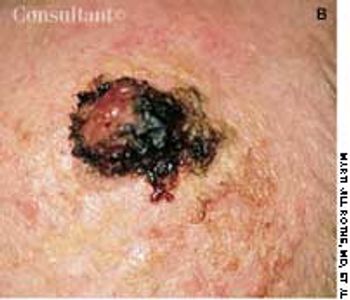
An 82-year-old man with Alzheimer's disease and atrial fibrillation was referred for evaluation of a lesion present for an undetermined period. It was initially noted 1 week earlier, at his first office visit with a geriatrician.
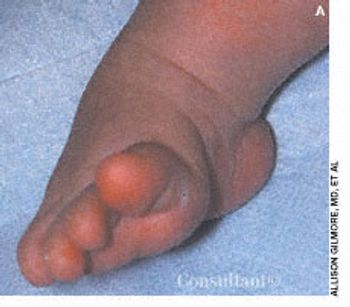
This 3-month-old boy has an untreated right clubfoot deformity. The foot is stiff and uncorrectable. The vertical midfoot crease indicates significant deformity. An anteroposterior (AP) simulated weight-bearing radiograph shows parallelism of the long axis of the talus and calcaneus; this indicates varus alignment of the hindfoot. There is also forefoot adduction.

The mother of a 2-year-old boy was concerned because his scrotum appeared flat and empty. (She had noticed this earlier but thought it was normal for her child's age.) On examination, the testicles were not palpable in the scrotum. They were found in the inguinal area and could not be manipulated into the scrotum. Bilateral orchidopexy was performed, and the postoperative course was uneventful.
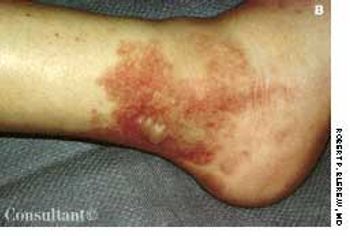
A 16-year-old girl was bothered by ankle pain and “red spots” on her lower legs. These symptoms cleared in a few days without treatment. Six weeks later, after returning from an all-day outing at a fair, she noticed that the spots reappeared and hemorrhagic lesions developed on the right ankle and left heel. After removing her shoes, the teen-ager felt severe pain in both ankles, particularly the right.

Livedo reticularis is the cutaneous manifestation most frequently associated with the antiphospholipid syndrome (APS). It manifests as a dusky, violaceous vascular discoloration with a reticulated pattern on the upper and lower extremities.
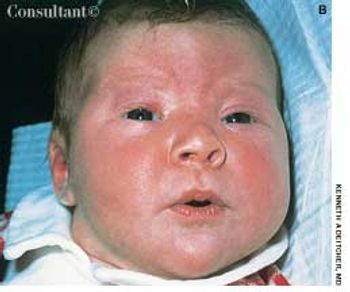
Dislocation of the triangular cartilage of the nasal septum is caused by pressure on the nose before and during delivery. It should not be confused with the transient flattening of the nose during birth.
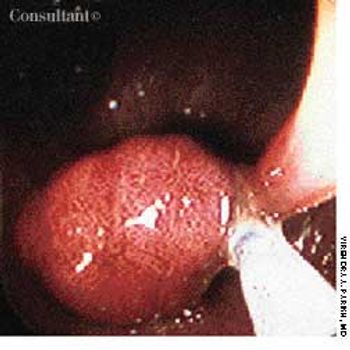
When a 59-year-old man's stool tested positive for occult blood, colonoscopic evaluation was carried out. This is the endoscopic appearance of a pedunculated colonic adenoma-the source of the bleeding-being removed by a snare.

Cirrhosis and ascites developed in a 52-year-old man with a history of chronic hepatitis C and ethanol abuse. He was hospitalized because of bleeding esophageal varices, which were successfully treated with elastic band ligation.
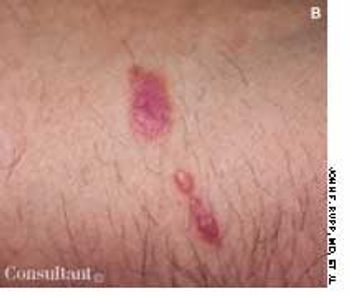
Lichen planus is characterized by flat-topped, polygonal, purple pruritic papules that have a predilection for flexor aspects of the wrists and forearms, sides of the neck, thighs, shins, and lower back. Lesions on the oral mucosa appear as white, lacy patches.
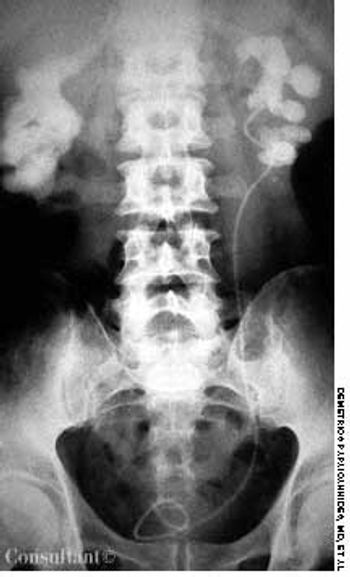
A roentgenogram of the kidneys, ureter, and bladder of a 58-year-old man shows bilateral stones in the renal pelvis and the renal calyces. The patient had a history of recurrent urinary tract infections caused by Proteus mirabilis. A ureteral catheter (pigtail) had been placed in the pelvis of the left kidney to facilitate drainage.

Skull x-ray films were taken after this 62-year-old nursing home resident fell and hit his head. The radiographs revealed only a sharply demarcated radiolucent area, mainly over the right parietal bone. Osteoporosis circumscripta was diagnosed.

A week after the onset of headache, fever, chills, nausea, weakness, and malaise, a 23-year-old man presented to the emergency department of a hospital on Long Island in New York. He reported that analgesics had not eased his symptoms. The patient's only past hospitalization was a splenectomy secondary to an auto accident at age 16.