All News

Orbital Floor Fracture

Four hours before he arrived at the emergency department, a 33-year-old man had been struck in the face by a rock. A laceration and periorbital hematoma were noted on the left side of the patient’s face. He complained of pain in this area. There was no history of intraocular disease. The left globe was intact, and no neurologic deficit was found.

Scrotal enlargement and pain of rapid onset prompted a 28-year-old man to seek medical attention.The testicle was displaced posterior and inferior in the engorged scrotum and wasdifficult to palpate.

A 30-year-old man presentedwith severe left flankpain radiating to his abdomenand gross hematuriaof 5 to 10 days’ duration.He also reported a 4- to 6-monthhistory of nausea with intermittentvomiting, anorexia, and progressiveweight loss. He took no medicationsand had no allergies.

Generalized Edema:

ABSTRACT: Restriction of fluid and salt intake is essential in patients with edema. Bed rest and supportive stockings are also helpful. However, diuretics are usually the mainstay of therapy. The effect of thiazide diuretics is relatively mild; they may be adequate in patients with cirrhosis but are ineffective in those with congestive heart failure (CHF) or nephrotic syndrome. Loop-acting diuretics can induce massive natriuresis and diuresis. Intravenous loop diuretics are preferred to oral agents for the relief of pulmonary edema. Acetazolamide, a carbonic anhydrase inhibitor, is commonly used in patients with glaucoma and is also recommended for those with CHF accompanied by metabolic alkalosis. Combination therapy is recommended for patients with refractory edema and normal or somewhat impaired renal function. The adverse effects of thiazide and loop-acting diuretics include renal insufficiency, hyponatremia, hypochloremia, hypokalemia, hypomagnesemia, metabolic alkalosis, hyperglycemia, and hyperlipidemia. These effects are typically reversed when the dosage is reduced or therapy is discontinued. Potassium sparing diuretics can cause life-threatening hyperkalemia.

For 24 hours, a 62-year-old woman had had severe weakness, abdominal pain, and watery diarrhea that had become bloody in the past 12 hours.She had no significant medical history.

For 3 days, a 47-year-old woman had a painful red swelling on her finger.The patient--a cellist--had tried to lance the lesion at home, but itprogressively worsened and was now “throbbing.” She denied fever andnail biting.

A 32-year-old woman presents with weight loss of 6.4 kg (14 lb) during the past 8 months and diarrhea of recentonset. Menstruation had ceased 10 weeks earlier. She appears anxious, with pressured speech. Physical examination detectsbaseline sinus tachycardia, sweaty palms, and a diffusely enlarged thyroid gland. Laboratory tests reveal a thyroid-stimulatinghormone (TSH) level of 0.00 µU/mL (normal, 0.45 to 4.5 µU/mL), a free thyroxine (FT4) level of 4.8 ng/dL (normal,0.61 to 1.76 ng/dL), and a positive thyroid-stimulating immunoglobulin (TSI) level with high titer.

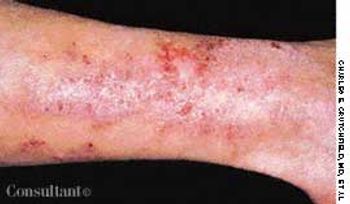
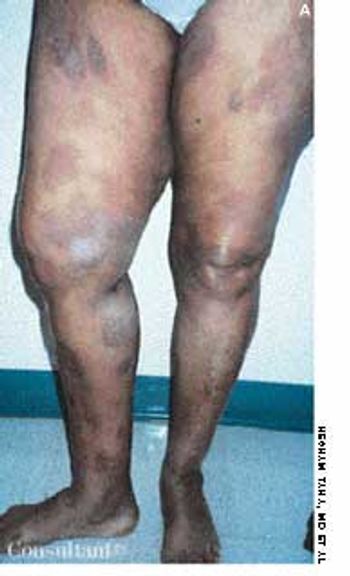
Swelling of the lower legs broughtthis 57-year-old woman to a familypractice clinic. She had a history ofhyperthyroidism with weight loss,tachycardia, and anxiety. This conditionwas confirmed with blood testsand radioactive iodine uptake testing.

This 17-year-old presented with a 1-month history of weight loss, increased appetite, mild insomnia, hand tremor, palpitations, sweating, heat intolerance, and quick loss of temper. The number of daily bowel movements had increased from 1 to 2. There was no family history of thyroid disorders.

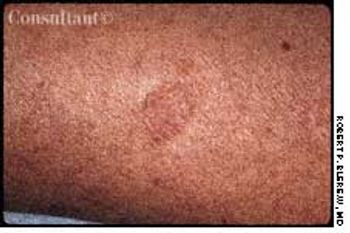
A mildly painful, nonpruritic rash on the forearms and legs prompted a 42-year-old man to go to the emergency department. The patient noted the rashwhen he awoke that morning. He had had joint pain and fever for the past7 days and generalized malaise with chills that began about 3 days earlier.He had no significant medical history.

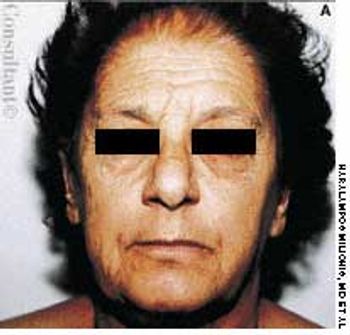
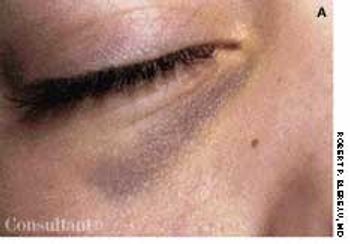
Hyperpigmentation is seen on the cheeks and eyelids of a 36-year-old woman.She became hyperthyroid at age 19 years, with accompanying exophthalmosand hyperpigmentation, following the birth of her first child. Thyroidectomywas carried out at that time, and the patient has been receiving thyroid replacementtherapy ever since. The hyperpigmentation, an uncommon accompanimentof hyperthyroidism, has persisted.

Because bariatric surgery has traditionally been associated with a high incidence of complications, it has been used primarily for superobese patients. A large body of evidence suggests that laparoscopic adjustable gastric banding is a much safer procedure that is also very effective. This procedure offers an additional option to patients who might benefit from bariatric surgery when diet, exercise, and pharmacologic approaches have failed. Here we address questions primary care physicians often ask about the procedure.

ABSTRACT: Acute and recurrent cystitis in young women, once identified, can be treated empirically without microbiologic confirmation. In these women, a urine dipstick test that is positive for nitrates or leukocyte esterase is considered diagnostic. The usual treatment is a 3-day course of an antibiotic. Prophylaxis is recommended for women who have more than 3 episodes of cystitis per year. Options include postcoital prophylaxis with a single dose of antibiotic or long-term low-dose antimicrobial therapy. In young women with acute pyelonephritis, fluoroquinolones are the treatment of choice. Empiric therapy is initiated as soon as possible in patients at risk for complicated urinary tract infections (UTIs). Alternative techniques, such as intermittent catheterization, may reduce the incidence of UTIs in patients with indwelling catheters.

ABSTRACT: Acute scrotal pain, a high-riding testicle, and the absence of the cremasteric reflex on the affected side signal testicular torsion-a surgical emergency. The pain associated with torsion of the appendix testis is usually of gradual onset and is exacerbated by movement. The tenderness is often localized over the infarcted appendix, and the infarction may be visible through the scrotal skin (the "blue dot sign"). Pain associated with epididymitis is usually gradual in onset; the patient may complain of dysuria, increased frequency, and discharge, particularly if the causative pathogen is Chlamydia trachomatis or Neisseria gonorrhoeae. Hydroceles are smooth and nontender, and the scrotum transilluminates. If the scrotum does not transilluminate and compression of the fluid-filled mass toward the external ring completely reduces the mass, then a hernia is the more likely diagnosis. A patient with a varicocele typically complains of a sensation of heaviness and of "carrying a bag of worms."

Hyperthyroidism:

ABSTRACT: Consider hyperthyroidism in patients who complain of anxiety or nervousness and palpitations. The diagnosis can be confirmed by measurement of thyroid-stimulating hormone, free thyroxine, and free triiodothyronine levels. Graves' disease is the most common cause of hyperthyroidism; more women are affected than men. A radioiodine uptake test and thyroid scan can distinguish among the various causes of hyperthyroidism. Reserve fine-needle aspiration and biopsy for patients with palpable thyroid nodules. Radioiodine ablation is the treatment of choice for most patients. Some patients, such as children, pregnant women, and patients with large goiters, may be candidates for total or partial thyroidectomy. Antithyroid medications-propylthiouracil and methimazole-are appropriate for patients with mild hyperthyroidism, pregnant women, and children and adolescents with Graves' disease.

ABSTRACT: Because of concerns raised by recent studies about the safety of hormone replacement therapy, attention has shifted to alternative therapies for prevention of osteoporosis. Resistance training has been shown to strengthen skeletal muscles, increase bone mineral density (BMD), and reduce fractures. Low-impact aerobic exercises, such as walking, improve cardiovascular fitness but do not create enough stress to increase BMD or muscle mass. A basic resistance training regimen consists of 5 or 6 weight-bearing exercises performed 2 or 3 times a week. Results can be seen in 4 to 6 weeks.

ABSTRACT: Urinary incontinence is a widespread disorder that remains underdiagnosed, underreported, and undertreated. Nevertheless, it is highly treatable. Components of the initial office evaluation include a focused history taking, physical examination, a postvoid residual urine volume measurement, and urinalysis. Behavioral interventions are first-line therapy. These include bladder training, pelvic floor muscle training, biofeedback therapy, and caregiver-dependent interventions. The antispasmodics oxybutynin and tolterodine are the most commonly used agents for urge incontinence. Stress incontinence can be treated with pseudoephedrine or topical vaginal estrogen. Imipramine may be helpful in cases of nocturnal or mixed incontinence. Overflow incontinence caused by an anatomic obstruction may be treated with an α-blocker.

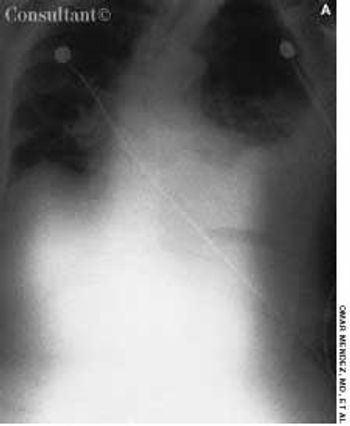
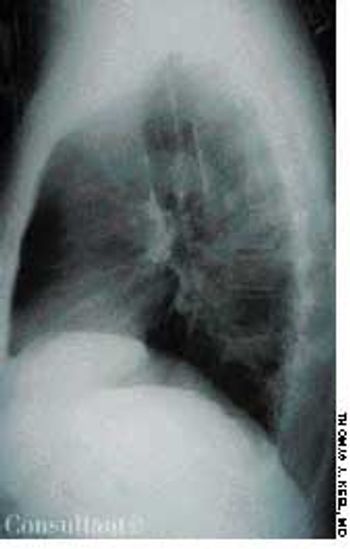
An obese 61-year-old man who hadchronic obstructive pulmonary diseaseand sleep apnea heard a “pop”in his stomach while lifting a heavyweight; severe abdominal pain followed.He was short of breath thenext morning, and his physician empiricallyprescribed cephalexin.

Over the previous 6 months, a59-year-old man had experienced lethargy,fatigue, poor appetite, cold intolerance,and abdominal distention. Hisvital signs were normal; physical examinationrevealed periorbital andpretibial edema, distant heart sounds,and delayed reflexes.