
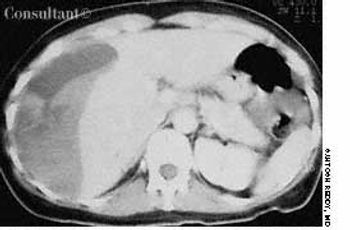
Intermittent right upper quadrant abdominal pain prompted a 42-year-old woman to seek medical consultation. Ultrasonographic examination of the abdomen revealed cholelithiasis; percutaneous gallstone dissolution was performed.
Intermittent right upper quadrant abdominal pain prompted a 42-year-old woman to seek medical consultation. Ultrasonographic examination of the abdomen revealed cholelithiasis; percutaneous gallstone dissolution was performed.
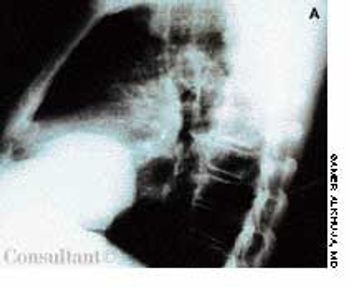
During the assessment of an 83-year-old man who had an infected arteriovenous graft, chest films showed a masslike density in the lower right hemithorax.
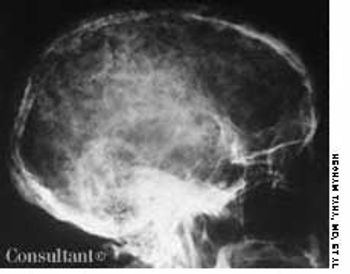
A 28-year-old woman reported that she was in good health before experiencing generalized weakness; exhaustion; and pain in her legs, shoulders, and back for the past 3 months. She also complained of shortness of breath with minimal activity, irregular menstrual periods, and occasional episodes of nose and gum bleeding.

An obese 56-year-old woman was hospitalized after 2 days of chest pain, shortness of breath, and palpitations. Physical examination revealed no abnormalities, and serial cardiac enzyme studies and an ECG ruled out myocardial infarction. However, transesophageal echocardiography showed a lesion in the mediastinum.
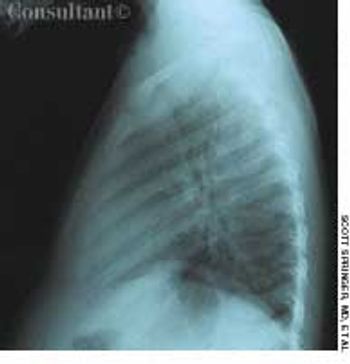
The parents of a 2-year-old boy with a 3-day history of fever took him to the emergency department. The child's temperature fluctuated between 38°C (100.4°F) and 39°C (102.2°F). As part of the workup, chest films were taken.

Following an uneventful pregnancy, a 25-year-old woman was delivered of an infant girl by repeat cesarean birth with occiput anterior presentation at 39 weeks gestation. The deformity was readily evident at birth.
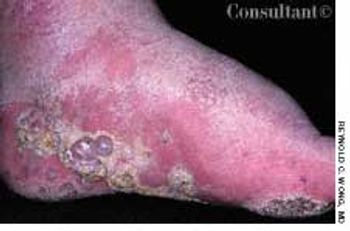
A 69-year-old man with a long history of lymphedema secondary to repeated cellulitis sought medical care for mildly pruritic, nontender, purple nodules that had erupted on the bottom and side of one foot 6 months earlier. Scale surrounded the nodules.
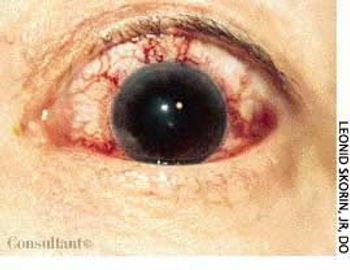
This 63-year-old woman's primary care physician had referred her to an ophthamologist because of her persistently red eye. She had been treated unsuccessfully for almost 3 weeks with several different antibiotic eyedrops. Her vision had begun to worsen, and she started to hear “swishing” noises. Pertinent medical history included a carotid endarterectomy on the same side as the red eye about 1 month before onset of the symptoms.

A 55-year-old man complaining of backache had localized tenderness at the paraspinal region over the posterior portion of the right 7th rib. A CT scan of the thorax revealed erosion of this portion of the rib, along with a space-occupying lesion that displaced the adjacent pleura and lung. Needle aspiration and biopsy study of this mass showed it to be a plasmacytoma.

A 12-year-old boy was brought to his physician because of a tensely cystic mass in the right side of the scrotum. The spermatic cord could be felt above and below the lump. It had no cough impulse.
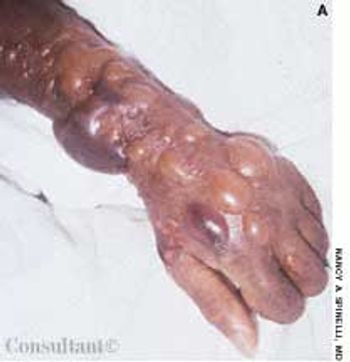
A 79-year-old nursing home resident was hospitalized for evaluation of hyperkalemia and leukocytosis. Her medical history included hypertension, respiratory failure with subsequent tracheostomy placement and ventilator dependency, and anemia. Both of her legs had been amputated above the knee secondary to complications of type 2 diabetes mellitus.
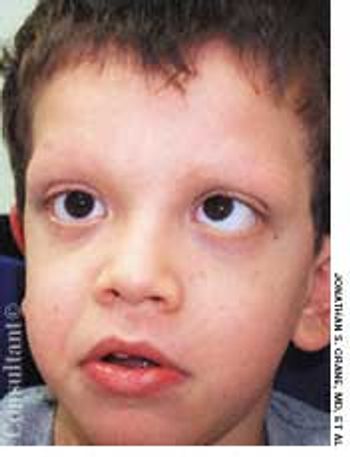
The mother of a 7-year-old boy with cardiofaciocutaneous syndrome sought treatment for the cutaneous aspects of her son's disease. Dry skin and keratosis pilaris of the upper outer arms were noted.
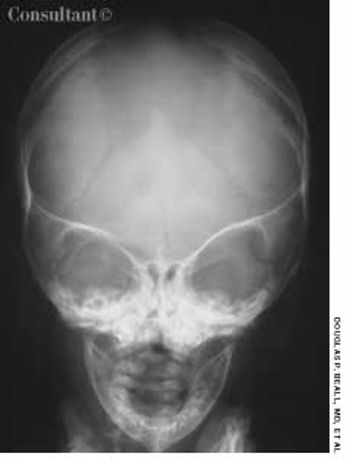
During his last routine pediatric visit, a 4-month-old boy with a large head circumference (98th percentile for his age) was referred for radiographic evaluation. The infant had been delivered by cesarean birth because of cephalopelvic disproportion; his head size had gradually increased since birth. There was a family history of this condition.

After 3 months of seeing this painless mass at the angle of the 3-year-old's left jaw, his parents sought medical advice for their son. The youngster had no constitutional symptoms. A Mantoux test was performed, and an erythematous, indurated area measuring 15 mm in diameter was found at the test site 48 hours later.

This erythematous, papulovesicular eruption developed in a hospitalized patient who had a febrile illness that was accompanied by drenching sweats. Miliaria rubra, or prickly heat, is caused by sweat trapped in obstructed eccrine glands of the epidermis. Inflammation, irritation, and pruritus can occur along with the rash.
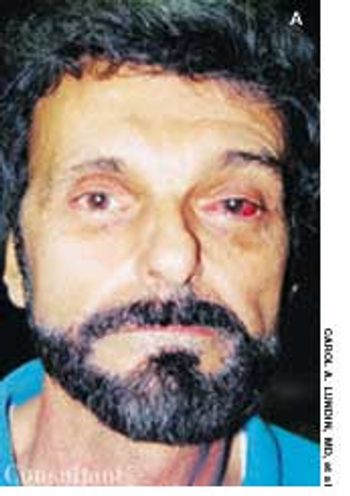
Redness, irritation, and diplopia developed over 2 to 3 weeks in a 55-year-old man's left eye. The injection worsened and was unresponsive to eye drops. Ptosis, mild proptosis, and elevated intraocular pressure developed. A bruit was auscultated over the affected eye.
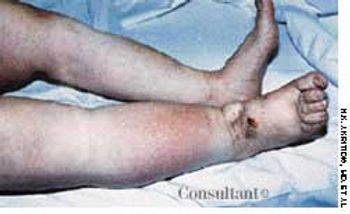
A 46-year-old woman was examined because of cellulitis of the right leg, which she said had been swollen for 30 years.

A 44-year-old woman was being seen regularly for skin manifestations of systemic lupus erythematosus (SLE). During a routine visit, blotchy erythema and hyperpigmentation were noted on the normally exposed areas of her neck and upper chest; the submental area was spared. Close examination revealed fine telangiectases and poorly marginated hyperpigmented and hypopigmented macules.
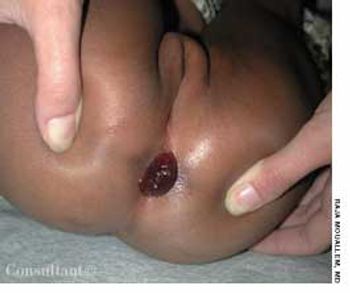
A 2-year-old girl presents to the pediatric emergency department (ED) for evaluation of a fleshy mass protruding from her rectum. The mass, which had been present for 1 day, protruded spontaneously and not during defecation. There is no history of cough, constipation, diarrhea, vomiting, weight loss, or parasitic or chronic disease. However, the child has been having episodic, painless bleeding during the past month. There is no family history of GI disease.
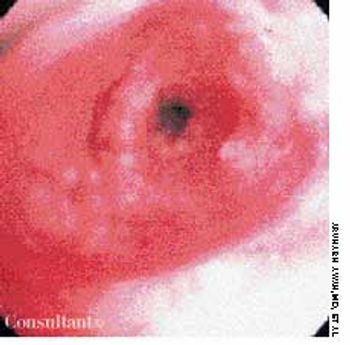
A 40-year-old man was being treated as an outpatient with inhaled corticosteroids and bronchodilators for a presumed diagnosis of bronchial asthma. Worsening episodes of shortness of breath during the past few months sent him to the emergency department for a second opinion.