

Focal, painless discoloration of theleft thumbnail (A) developed severalyears earlier in this 46-year-old man.Oral antifungal therapy had no effecton the lesion.
Focal, painless discoloration of theleft thumbnail (A) developed severalyears earlier in this 46-year-old man.Oral antifungal therapy had no effecton the lesion.
A 35-year-old man presents with extensiveplaques over much of thetrunk and extremities. This severeflare of psoriasis developed after astressful emotional experience.
A 60-year-old man with a long historyof psoriasis vulgaris required a systemiccorticosteroid for a severe exacerbationof asthma. Soon after theErythrodermic or Pustular Psoriasiscorticosteroid was discontinued, generalizederythema and scaling of theskin developed.
Both clinicians and patients were surprised by the withdrawal of cerivastatin from the US market in 2001 because of reports of serious myopathy, including severe rhabdomyolysis.
ABSTRACT: Correction of chronic hyponatremia is associated with a very high risk of CNS complications; avoid a rapid increase in serum sodium concentration if you suspect a patient's condition is chronic. Thiazide- or metolazone-induced hyponatremia can develop rapidly-in 1 to 2 weeks-and its only presenting signs may be fatigue and listlessness. Diuretic-induced hyponatremia is 4 times as common in women as in men. Various factors greatly increase the risk of acute hyponatremia after surgery. Hyponatremia that develops after an operation which involves irrigation with a solution of glycine, mannitol, or sorbitol (such as transurethral prostatectomy [TURP] or hysteroscopy) may be hypertonic. An osmolar gap greater than 15 is a clue to this condition. Treatment of hypertonic hyponatremia in post-TURP or posthysteroscopy syndrome may require dialysis and a nephrology consult.
Consider a concentrated solution(10 mg/mL) of doxepin for patientswith fibromyalgia who experienceside effects with other tricyclics ateven 10-mg doses.
A 43-year-old woman was admitted to the hospital withleft flank pain. The physical examination revealed a left abdominalmass. Laboratory test results identified normochromic-normocytic anemia (hematocrit, 33%; hemoglobin,10.8 g/dL; and mean corpuscular volume, 88 fL) andmicroscopic hematuria (10 red blood cells per high-powerfield).
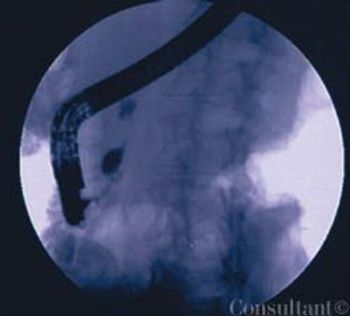
A 74-year-old man had vague abdominal pain, jaundice, pruritus, gray stools, and dark urine. A painless, palpable mass in his right upper quadrant was found at examination.
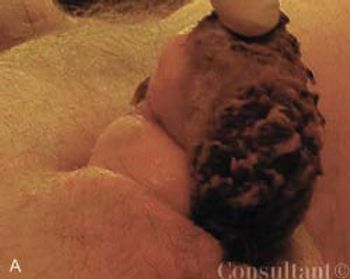
A 38-year-old man presented with a fleshy lesion beneath the tip of his penis. He had discovered it about 18 months before the initial evaluation. A second similar lesion resembling a “cauliflower” had appeared several weeks after the first. Both lesions had grown and had begun to bleed during intercourse.
A previously asymptomatic, largeblack plaque on a 65-year-old man’sscalp recently began to bleed. The lesionhad grown considerably since itfirst appeared as
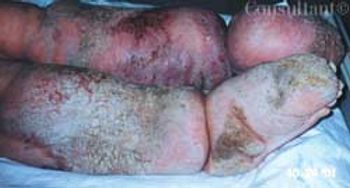
A 40-year-old man presented with a 5-year history of progressively increasing bilateral leg swelling that was neither painful nor pruritic. There was no history of dyspnea, jaundice, or groin surgery. The patient reported multiple previous episodes of superimposed cellulitis, which were treated with antibiotics. There was no family history of similar illness.
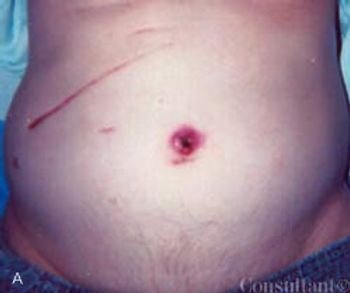
An 85-year-old man presented with intermittent abdominal pain of several years’ duration. Two years earlier, he underwent a laparoscopic cholecystectomy that was converted to an open procedure.
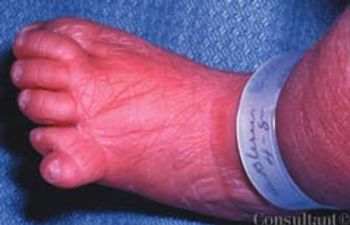
This 2-day-old infant was noted by Robert P. Blereau, MD, of Morgan City, La, to have duplication of the fifth toe with webbing between the two toes to the distal interphalangeal joint. There was a family history of polydactyly on the paternal side and syndactyly on the maternal side.
ABSTRACT: In addition to advanced age, factors such as comorbid illness and debility determine the risk of community- acquired pneumonia (CAP). Many elderly persons do not have the classic symptoms of CAP; instead, they may present with confusion, lethargy, tachypnea, anorexia, or abdominal pain. Even with thorough investigation, an infectious pathogen can be identified in only about half of patients. In addition to the causative organisms for pneumonia in younger adults, elderly persons are at risk for infection with organisms such as Haemophilus influenzae, Staphylococcus aureus, enteric gram-negative bacteria, and anaerobes, and for polymicrobial infection. Prompt empiric treatment is essential. Recommended initial therapy choices include a ß-lactam agent with a macrolide, or an antipneumococcal fluoroquinolone.
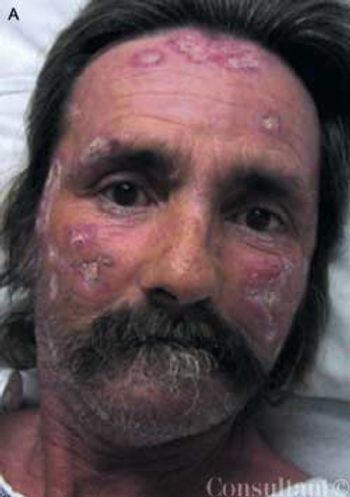
Bullae had recently appeared on the dorsa of the hands and fingers of a 46-year-old man. His medical history was significant for alcoholism, discoid lupus erythematosus (DLE), and hepatitis C. Systemic lupus erythematosus (SLE) was ruled out; the patient’s symptoms did not meet the American Rheumatism Association criteria for SLE.
For several days, a 60-year-old woman has had fever, myalgias,fatigue, poor appetite, and diminished oral intake. Shedenies cough, sputum production, and urinary symptoms.
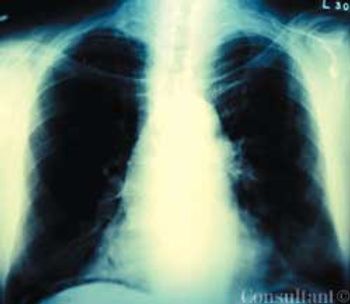
A 75-year-old man was brought to the emergency department with fever, cough, and abdominal pain of 2 days’ duration. The pain was most severe in the epigastric and umbilical regions. The patient’s history included type 2 diabetes mellitus, hypertension, and hypercholesterolemia. He had smoked cigarettes for 40 years and recently lost 50 lb. The patient was tachypneic and diaphoretic.
The Geriatric Depression Scale is the most widelyvalidated screening tool. The questionnaire has beenreduced to a single question that is as sensitive and as specificas the 15-item shortened form of the original 30-itemscale. The question is: "How often do you feel sad or depressed?'This is certainly something that is easy to ask inthe course of a general physical examination or routine officevisit.
ABSTRACT: Infant colic is a diagnosis of exclusion; its true cause is not known. To rule out alternative diagnoses, obtain a detailed history, look for clues to an underlying organic disease or genetic syndrome, and perform regular head-to-toe physical examinations. The interventions most commonly used to treat colic include modification of parental behavior (such as increased carrying of the infant or decreased infant stimulation), milk- and/or soy-free formulas, modifications in the diet of a breast-feeding mother, soothing measures (such as car rides, rocking, or use of a pacifier), anticholinergic agents, sedatives, and alternative medicine approaches (such as sucrose solution, herbal teas, or infant massage). The medications used to treat colic-such as antispasmodics and anticholinergics-can have serious adverse effects; discuss the pros and cons of drug therapy with parents before prescribing these agents. Remind parents that colic resolves by age 3 to 4 months, regardless of the intervention used.
A 12-month-old infant is brought to your office for evaluation of ared, swollen left index finger, which her parents first noted the prior evening.The mother denies any known trauma or recent illness. She tells you that theinfant is slightly fussy and is not taking her bottle as well as usual.