

My patient reports that erythemanodosum occurred when she took anoral contraceptive (OC) in the1990s.
My patient reports that erythemanodosum occurred when she took anoral contraceptive (OC) in the1990s.
Heart failure(HF), the mostcommon Medicarediagnosisrelatedgroup,has a significant and growingimpact on health careresources. The incidenceof HF has tripled during thelast decade. Almost 5 millionAmericans have HF, and anestimated 500,000 new casesare diagnosed yearly. Thelifetime risk of HF is about20%.1 Drug therapy has improvedconsiderably in recentyears, but the magnitudeand severity of theproblem has created a needfor newer therapies--particularlysince HF is associatedwith an increased risk ofsudden death and a diminishedquality of life.2
The parents of a 3-year-old boy were concerned about their son's "droopy" right eyelid; the abnormality had been present since birth.
A 58-year-old man recently underwent coronary artery bypass graft (CABG)surgery after emergent cardiac catheterization for a myocardial infarction revealeddiffuse 3-vessel disease.
The most appropriate choice is B. The history andphysical findings suggest that the patient may have afracture or contusion of the foot from trauma. There areno systemic signs that suggest an underlying infectious,chronic inflammatory, or oncologic process. A plain x-rayfilm of the foot is necessary to seewhether a fracture is present andwhether immobilization will be necessary.In the absence of fever and localerythema, infection appears unlikely,and a CBC count is unwarranted.
My patient is a 48-year-old woman who has no significant medical history andtakes no medications or supplements.
Approximately 2 weeks earlier, a pruritic,papular eruption had developed overthe abdomen of a 33-year-old womanwho was 34 weeks' pregnant. Therash was confined mainly to the striaedistensae (Figure 3). Because thesite was severely pruritic, the patientwas unable to sleep. Based on theclinical presentation, pruritic urticarialpapules and plaques of pregnancy(PUPPP) was diagnosed.
Many of my older women patients think theyare at much higher risk for breast cancer thancoronary heart disease (CHD). How can we raise women'sawareness about their risks of CHD and therebyencourage them to take measures to prevent it?
A 24-year-old woman's firstpregnancy was uneventful until thesixth month when mild malaise and ahighly pruritic abdominal rash occurred(Figure 1). A biopsy and directimmunofluorescence confirmedthe suspected diagnosis of herpesgestationis.
In their report of a young man who had dislocated his shoulder during a fight,Drs Gary Quick and Gale Joslin described a well-known technique for reduction ofthe dislocation (CONSULTANT, July 2001, page 1100y).
Although many patients with primary HSV-1 infection have no clinicalrecurrences, the failure to seroconvert occurs very seldom-inno more than 1% of patients.
Dr Gregory Rutecki's interactive teaching case, “A Middle-Aged Man WithPolyuria: The Initial Visit” (CONSULTANT, March 2001, page 357), provided awelcome opportunity for me to review the care I provide to my patients with type 2diabetes, who comprise a very large percentage of my practice.
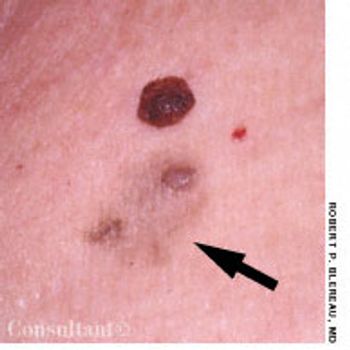
Two asymptomatic lesions that had been present for 1 year on the left upper chest of a 61-year-old man were excised. Pathologic examination revealed the raised, dark brown medial lesion to be an interdermal nevus; the lateral, light tan lesion with papules was a papillomatous interdermal nevus with primary macular amyloidosis.
When patients cite muscle pain and discomfort as an excuse for not exercising regularly, suggest they try an approach that athletes use. Taking Alka-Seltzer after working out can make muscle-building less painful. Alka-Seltzer contains sodium bicarbonate and aspirin; the sodium bicarbonate alkalinizes the lactic acid produced by the muscles during exertion, and the aspirin helps ease the pain while the kidneys flush the toxins.
A 72-year-old man slipped and fell backward in the bathroom, hitting hishead on the toilet seat; he suffered only minimal discomfort. The followingday, he presented with mild back pain and extensive bruising.
The parents of a 3-year-old boy bring him to your office after hecomplains of genital pain. The child is otherwise healthy; there is no knownhistory of trauma or difficult urination. The child has a low-grade fever and isin mild discomfort.
A 28-year-old man presents tothe emergency departmentwith high fever; progressive, severe,generalized, throbbing headache;blurred vision; and increasingconfusion. These symptoms started3 days earlier.
The results of a preoperative serum protein electrophoresis (SPEP) test wereabnormal in a 72-year-old man who underwent a successful hernia repair2 weeks earlier.
As skateboarders and scooter riders take to the streets this summer, the riskof serious injuries related to these sports increases. Most of those injured arechildren and adolescents. To help you protect your young patients this summer,the American Academy of Pediatrics (AAP) has developed recommendationsfor the safe use of skateboards and scooters.1

For several months, a 52-year-old woman had nausea, mild dysphagia with solid food, vague abdominal pain, and diarrhea. The patient denied hemoptysis, hematochezia, and melena. Lansoprazole and dicyclomine provided minimal relief of her symptoms.