

All News

As the world of sport has embraced the participation of women and girls, the incidence of health problems that pertain specifically to premenopausal female athletes has increased significantly. One of these is the female athlete triad, which consists of 3 interrelated medical conditions associated with athletic training
A 72-year-old man is brought to the emergency department by his wife. Hecomplains of nausea, vomiting, and severe abdominal pain that makes it difficultfor him to walk. The pain began the previous afternoon and has worsened steadily.The patient denies trauma and recent foreign travel. His history includes an appendectomyperformed many years earlier but is otherwise noncontributory.

Herpes Zoster Ophthalmicus

A previously healthy elderly woman reports that she has hadunilateral facial pain and crusting skin lesions for several days. She decides toseek medical care because of concomitant impaired visual acuity.

Drs Sonia Arunabh and K. Rauhilla’s case of a 62-year-old woman with Raynaud’sphenomenon (CONSULTANT, September 15, 2001, page 1526) offers one ofthe finest photographs of this condition that I have seen (Figure).

Over the years, a 78-year-old man hadnoticed a progressive drooping of theright upper eyelid, which finally occludedhis right pupil and obstructedhis vision. Although the droopingworsened as the day went on, the ptosiswas evident even when the patientawoke in the morning. He denied anyophthalmic or periocular surgery ortrauma. He was otherwise healthy andhad no other neurologic complaints.

A 72-year-old man sought medical evaluationafter he awoke and was unableto open his right eyelid (A). He deniedpain, recent trauma, and diplopia. Thispatient’s history included well-controlledhypertension and hypercholesterolemia,for which he was taking atorvastatin.He did not have diabetes.

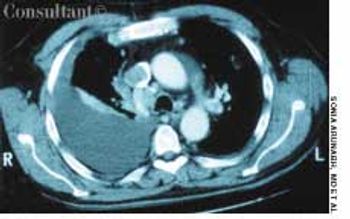
A 64-year-old woman with a history of diabetes, hypertension, and lymphoma was admitted to the hospital with a dull headache, conjunctival congestion, and slight dyspnea. Her pulse rate was 96 beats per minute; blood pressure, 146/68 mm Hg; and respiration rate, 22 breaths per minute. She also had increased jugular venous distention; cardiovascular and chest examination findings were normal. Edema of both arms and dilated blood vessels on the anterior chest wall were noted.

A 62-year-old woman presented with a rash and intermittent pain of the right upper quadrant. The reticular, brown hyperpigmentation was also seen on her right flank and around the umbilicus. The patient reported that she often applied heating pads to these areas for pain relief.

Save Time-Save the Label

Instead of throwing away the label from an injectable medication, peel it off and tape it to the patient’s chart. The nursing staff will not have to write the drug information on the chart because the label contains the name, unit dose, and lot number.

Lend a stethoscope to hard-of-hearing patients who are not wearing a hearing aid. Speak directly into the stethoscope diaphragm, and the patient may hear well enough to communicate with you. Be sure to clean the stethoscope's ear tips before and after the patient uses it.

To reduce discomfort when administering potassium in a peripheral line, mix in 2 mL of a 1% lidocaine solution. This may also work with other painful IV medications, but first check with the pharmacy for drug interactions.

A 63-year-old woman seeks evaluation of a persistent, rough, red area onthe dorsum of her left index finger. The lesion has been present for severalmonths. The patient’s manicurist is convinced it is a wart.

A 13-year-old boy presents with swelling of the left eyelidsthat started 12 hours earlier; the eyelashes are mattedwith yellow discharge. He does not wear contact lenses oreyeglasses and denies ocular trauma or foreign bodies. Hehas been nauseated and has vomited once; his motherattributes these symptoms to an antibiotic that was prescribed5 days earlier for a sinus infection. Medical historyis noncontributory; there is no family history of ocularproblems.

Acquired Ptosis-Traumatic

This 40-year-old man was punched inthe left eye the night before his evaluation.Traumatic ptosis of the left uppereyelid with accompanying edema andperiorbital ecchymosis (A) were found.When the ptotic eyelid was lifted andheld in place with tape, conjunctivalinjection and traumatic mydriasis wereseen (B). The patient had no complaintsof diplopia; the remainder of theeye examination was unremarkable.

A 35-year-old woman noticed that herright upper eyelid started to droop asthe day progressed. She denied otherocular problems, including decreasedvisual acuity, pain, or diplopia. The patienthad no generalized fatigue, difficultyin swallowing, or weakness ofher arms or legs.

The parents of a 3-year-old boy wereconcerned about their son's "droopy"right eyelid; the abnormality hadbeen present since birth. All other aspectsof the child's eyes and his generaldevelopment had been normal.