

An 81-year-old man is seen for follow-up of leukocytosis detected during a recent hospitalization for community-acquired pneumonia. The leukocytosis had not resolved by the time he was discharged.
An 81-year-old man is seen for follow-up of leukocytosis detected during a recent hospitalization for community-acquired pneumonia. The leukocytosis had not resolved by the time he was discharged.
Some studies suggest that orally administered dapsone is effective for infections caused by spider bites (eg, brown recluse spiders) in dosages of 4 mg/kg/d for 3 days. Can dapsone be used in children and, if so, at what dosage?
A previously healthy 40-year-old man presents with a 2-hour history of excruciating colicky pain of acute onset that emanates from the right flank and radiates to the groin. He rates the severity of the pain at 9 on a scale of 1 to 10. Before arriving at the emergency department, the patient experienced nausea and 2 episodes of nonbilious, nonbloody vomiting.
Elderly patients who take many medications often have difficulty in remembering them all.
A Wood UV lamp is useful in a wide variety of primary care settings.
If a child is screaming when you examine his or her ears, the tympanic membrane is likely to be red, which can make diagnosing otitis media difficult.
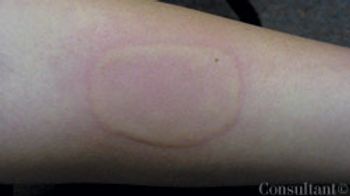
For 6 months, a 19-year-old woman had had sensitivity to cold. When outside in cold weather, she noticed swelling, erythema, and pruritus of her uncovered hands. After she held a cold drink on her arm for about 5 minutes, urticarial lesions developed on the skin in contact with the drink. The symptoms resolved about 20 minutes after the cold source was removed. She denied angioedema, respiratory symptoms, light-headedness, and tachycardia.
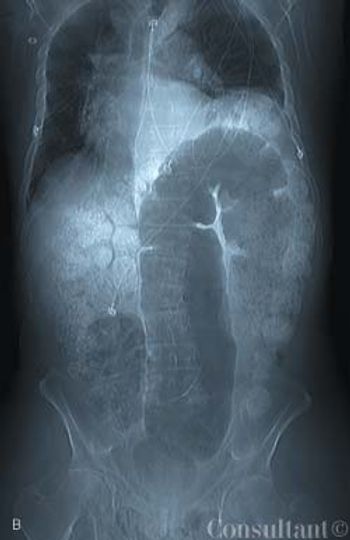
A 70-year-old man was hospitalized after he fell and was unable to rise because of weakness. He denied dyspnea, chest pain, palpitations, vertigo, light-headedness, preceding aura, hematemesis, hematochezia, and melena. For the past year, the patient had had intermittent low-volume, watery diarrhea that had recently begun to occur daily; he had also lost 13.5 kg (30 lb) during the past 6 months. Shortly after he was admitted, scrotal edema, discoloration, bullae, and erythema of the upper left thigh developed.
This is an autosomal recessive syndrome characterized by chromosomal breakage, pancytopenia, and various congenital abnormalities. It is a heterogeneous condition clinically and has been linked to defects in at least 8 different genes. Fifty percent to 65% of affected persons demonstrate areas of hyper- or hypopigmentation. Café au lait macules, like those shown in Figure A in a 9-year-old boy, are seen in approximately 25% of those affected.
These sinuses are lined by a membrane. When this membrane becomes inflamed--usually as a result of an infection or obstruction--you can get sinusitis. Sinusitis can be acute, recurrent, or chronic. Acute sinusitis responds well to treatment within a few weeks. Recurrent sinusitis is characterized by episodes that repeat at least 4 times a year. Sinusitis is considered to be chronic when symptoms persist for at least 12 weeks after treatment of acute sinusitis has ended.
Abstract: Many patients with sarcoidosis are asymptomatic at presentation and have bilateral hilar adenopathy on a chest radiograph obtained for other reasons. Symptomatic patients usually present with chronic cough, dyspnea, or noncardiac chest pain. Extrapulmonary organ involvement is not uncommon. Lung biopsy shows well-formed noncaseating granulomas in a bronchovascular distribution. Interstitial lung disease also may result from collagen vascular disease, such as systemic lupus erythematosus and Sjögren syndrome. In patients with acute hypersensitivity pneumonitis, cough, dyspnea, and flu-like symptoms occur within 12 hours of exposure to the inciting antigen, such as pigeon stool or moldy hay. Some patients have a subacute or chronic course, probably as a result of continued exposure to the offending antigen. In acute hypersensitivity pneumonitis, the chest radiograph may show diffuse small nodules, whereas in chronic disease, reticular lines or fibrosis may be seen. (J Respir Dis. 2005;26(10):443-448)
The Internet has made a wealth of medical information readily available, and study results and recommendations from government agencies and professional societies continue to be released at a dizzying pace. Critically dissecting the literature to separate the wheat--or what is clinically relevant--from the chaff is a herculean task.
A palpable nodule on the right lobe of the thyroid gland is detected in a 55-year-old woman. The nodule is firm and nontender and moves freely.
A 4-year-old boy is admitted with a 2-week history of high fever with rigors; profuse night sweats; progressive dull, aching, nonradiating right upper quadrant pain; and watery, foul-smelling diarrhea that contains no blood or mucus.
Could a patient who lives in Canada have a bite from a brown recluse spider?
A 68-year-old man with a prosthetic mitral valve presents to the emergency department with acute abdominal pain, nausea, vomiting, and constipation. Surgical evaluation is performed; the results suggest a complete bowel obstruction. Urgent celiotomy is recommended.
For patients with cardiovascular risk factors, the most serious complication of noncardiac surgery is a perioperative cardiac event, such as myocardial infarction or sudden death. The preoperative cardiac assessment is an essential tool for identifying patients at risk for cardiac complications and for recommending appropriate strategies to minimize risk.
Skin signs of systemic disease: sarcoidosis, rheumatoid nodules, Muir-Torre syndrome, diabetic vasculopathy, hyperlipidemic nodules, zinc deficiency, and Sister Mary Joseph nodule.

Numerous flat, brown lesions with sharp, irregular borders had been present on the upper extremities, abdomen, back, and the proximal legs and neck of a 28-year-old woman for 4 months. The asymptomatic lesions--some with a narrow, slightly raised halo--were more pronounced on the anterior and posterior trunk.

A 14-year-old girl presented with concerns about a "deformed" right shoulder. Despite the fact that there was no associated weakness, the defect made her self-conscious. She denied recent trauma to the site and severe physical exertion.