
















































































































































Dermatology

Latest News


CME Content


A 60-year-old man was hospitalized with fever and hypotension secondary to recurrent cellulitis of the left leg. He had a history of polysubstance abuse and hepatitis C. Elephantiasis nostras verrucosa was diagnosed based on bilateral nonpitting edema and hyperkeratotic verrucous lesions in the pretibial area. The patient's erythrocyte sedimentation rate and white blood cell count showed evidence of infection; osteomyelitis of the left fifth metatarsal head was suspected.

A 13-year-old girl noticed that the skin around a "mole" on her abdomen had gradually changed color. This patient was told that she had a halo nevus--a pigmented (nevocellular) nevus surrounded by a tight ring of depigmentation--which is benign and usually regresses spontaneously over time.

A middle-aged man hospitalized for intensive pulmonary toilet and topical and systemic treatment of a refractory skin disorder. Cough and moderate dyspnea with even mild exertion. Complains of scaling, uncomfortable dermopathy that he finds deeply cosmetically disfiguring and emotionally distressing.

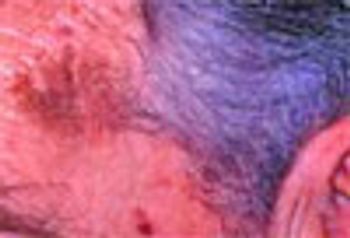
A 65-year-old woman seeks evaluation of a tender, pruritic patchy rash on the trunk and extremities, as well as tender lips. Her symptoms began after she started taking a new NSAID for osteoarthritis. She has no known drug allergies and has not changed any other medications. The photographs were taken 2 days apart.

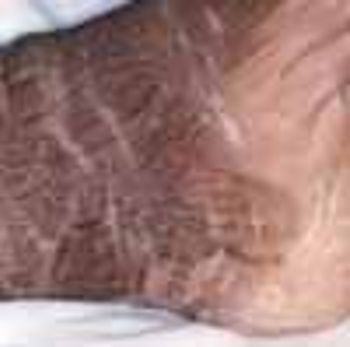
A linear, severely pruritic rash erupted on the lateral and plantar aspectsof the left foot (A) of a 72-year-old woman who had recently been campingon a Caribbean beach. Antihistamines and locally applied antifungal agentsoffered no relief.

Loss of pigmentation was noted around the left eyeof a 49-year-old man-the same eye in which hehad a detached retina. In addition, the patient'shearing was impaired on that side. These findingswere consistent with the diagnosis of Alezzandrinisyndrome, the major manifestations of which includeunilateral degenerative retinitis, ipsilateral facial vitiligo,poliosis of the eyebrows and eyelashes, and ipsilateralhearing deficits.

ABSTRACT: A 4-pronged approach that includes patient education, skin and nail care, appropriate footwear, and proactive surgeries can effectively prevent diabetic foot problems. Teach patients with diabetes to examine their feet daily to detect new onset of redness, swelling, breaks in the integrity of the skin, blisters, calluses, and macerated areas. Have them follow a daily foot care regimen that includes warm water soaks and lubrication, and have them keep toenails properly trimmed. Recommend that patients select shoes that fit properly and have sufficient padding and toe box space; have them use inserts, lifts, orthoses, or braces--as recommended-to correct abnormal gait patterns. Finally, if deformities develop, simple proactive surgical procedures can correct these problems before they result in the development of wounds.

This polymicrobial infection, characterized by rapidly advancing deep tissue necrosis, is caused by Gram-positive and Gram-negative bacteria and anaerobes such as Escherichia coli, Klebsiella pneumoniae, and Pseudomonas aeruginosa.

Declining cardiovascular function, poor circulation, diabetes, obesity, cancer, immunodeficiency, renal disease, and thinned, xerotic skin provide the setting for a host of bacterial infections in elderly persons that can involve any level or structure of the skin.

This vesiculopustular eruption manifests with honey-colored crusted erosions. As it resolves, the crusts can turn brown; hyperpigmentation and scale may be evident.

Folliculitis, which features vesicles filled with white blood cells (pustules), usually affects hair-bearing sites, such as the scalp, neck, beard area, axillae, buttocks, and limbs.

This lesion on her knee had been present for 5 years, reported a 22-year-old woman. It was not related to any trauma; its size had not changed, but occasionally it became darker or lighter. Excisional biopsy revealed lymphangioma circumscriptum, a benign, hamartomatous malformation of dilated lymph channels that may be filled with clear fluid because of communication with deeper lymphatics or, as in this case, serosanguinous fluid.

A thriving boy was brought to the office 3 weeks after his first birthday. His mother reported that there was something wrong with his knee. On visual examination, the knee appeared perfectly normal. On palpation, however, a 4-cm linear induration was evident over the knee fat pad, just medial and distal to the patella. It appeared soft, crepitant, and associated with the skin. No tenderness was noted on palpation; the infant did not object to palpation of this density any more than to auscultation, otoscopy, or anthropometric measurements.

To facilitate the assessment of jugular venous pressure, shine a beam of light tangentially across the skin overlying the jugular vein while the patient's neck muscles are relaxed.

Suggest that patients make a "rice sock" whenever they have a musculoskeletal injury, abscess, stye, or other condition that might benefit from heat therapy. Tell them to pour uncooked rice (the amount depends on the size of the area to be treated) into a clean cotton tube sock, tie off the open end of the sock, then microwave it for about 1 minute until warm (not hot). A rice sock holds heat longer than a hot towel and molds itself to the body part being treated.

This 3-mm, purplish pink papillary lesion with a crusted top had been present for 6 months at the outer vermilion border of the lower lip of a 65-year-old man. The lesion was asymptomatic.

A pruritic rash under the left breast has bothered a 67-year-old woman forthe past month. She takes an antihypertensive and is otherwise healthy.

A 52-year-old woman presents with a3-month history of a tender, erosivedermatitis on the nipples and in thevulvar/perineal region. Can youidentify these lesions?

For the past week, a 16-year-old boy has had a progressively worsening dry, irritating cough; dyspnea on exertion; and intermittent fever and chills. During the past 24 hours, he has had no appetite and has vomited greenish material 3 or 4 times.