















































































































































A 22-year-old Chinese man presented with a patch of increased hair growth on his back. The hair first appeared 9 years earlier, and the area of growth slowly expanded until 3 years ago.


A 22-year-old Chinese man presented with a patch of increased hair growth on his back. The hair first appeared 9 years earlier, and the area of growth slowly expanded until 3 years ago.

A 25-year-old woman presents for a prenatal visit. She has an unremarkable medical history except for hypermobility of the joints and a tendency to bruise easily. Her mother and sister also have very lax joints.

For 6 weeks, a 68-year-old woman had had sharp pain in the left breast that radiated to the left arm and back. The pain was worse on palpation; ibuprofen provided only mild relief. She denied nipple discharge, skin discoloration, and fever. She had no family history of breast cancer. Results of a biopsy of the left breast 6 years earlier were benign. Her most recent mammogram, 4 weeks earlier, was negative.

Swelling of the wrists and ankles of 3 months' duration prompted a 33-year-old man to seek medical attention. The swelling was highly migratory, with periods of regression that lasted several days at a time. The patient also had a 3-year history of "breaking out" after contact with water. He had no personal or family history of asthma, allergies, or other atopic disorders. He was not taking any medications.

A Photo Quiz to Hone Dermatologic Skills

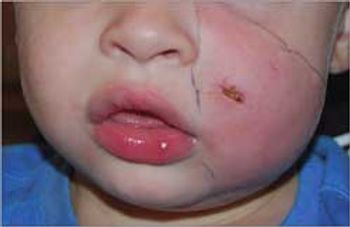
The 2-year-old boy shown here had been bitten on the left cheek by a medium-sized dog while at the home of his day-care provider. Immediately after the incident, the child was examined by his pediatrician and given a presciption for amoxicillin clavulanate. The next day, he presented to the emergency department with worsening cellulitis of the left cheek.

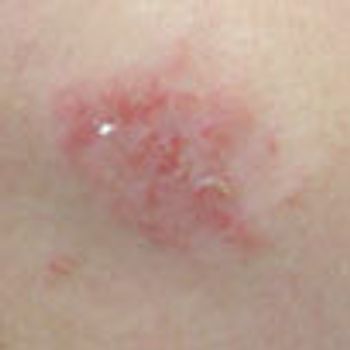
An 18-year-old girl presented with a red, scaly rash on her cheeks that had been scabbing over, peeling, and draining. She had had similar reactions to earrings and inexpensive jewelry. The appearance of the rash coincided with the use of a new cell phone.

A 54-year-old woman presents with an asymptomatic rash of sudden onset on both malar cheeks that developed 1 day earlier. She denies any facial trauma.

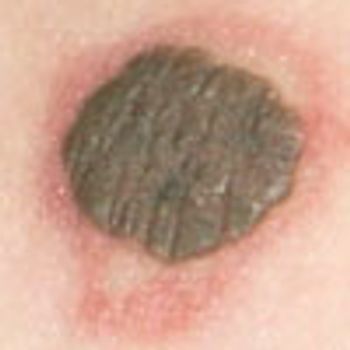
This darkly pigmented lesion on the left arm of a 27-year-old man had been present since birth and had slowly enlarged over the past 2 months. Two days earlier, another physician had diagnosed a wart and treated the lesion with liquid nitrogen, which caused erythema of the surrounding skin.

I'm sure our office has many rulers, but I often do not have one readily available during a skin examination. When this happens, I have found that knowing the width of the nail on my index finger comes in handy.

Tinea is caused by dermatophytes that can infect the stratum corneum epidermidis, hair, and nails. Dermatophytosis is a common infection worldwide, and about 20% of the US population is infected.1 Although numerous fungi can cause tinea, Trichophyton, Microsporum, and Epidermophyton are the genera that cause most cases of tinea.2 Classified by the part of the anatomy that is infected, tinea is referred to as tinea pedis, tinea manuum, tinea cruris, tinea corporis, tinea capitis, tinea faciei, tinea barbae, and tinea unguium.

For several years, a 71-year-old man has had a mildly pruritic rash on his legs that develops every winter and resolves when the weather becomes warmer. He is scheduled to undergo knee surgery, but the surgeon refuses to perform the operation until the rash has cleared.

Half way through a 15-minute iontophoresis treatment for de Quervain tenosynovitis of the right wrist, a 42-year-old woman felt exquisite pain but completed the session. After the therapist returned to the room and removed the electrodes, a light gray circular mark about 5 mm in diameter was noted on the skin. The epidermis was gone, and the underlying dermis was also injured. Within 6 hours, a tender, dark red-brown lesion developed.

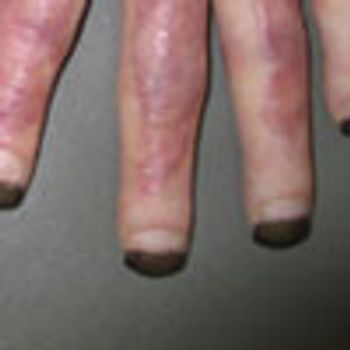
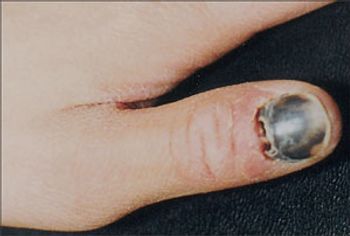
Black discoloration appeared on the fingernails of a 51-year-old white man who had sustained burns on 15% of his body in a house fire 2 months earlier. The discoloration is a typical side effect of silver nitrate, which was applied to his skin and fingernails during the month he was hospitalized. This topical broad-spectrum bacteriostatic agent is used to reduce the risk of infection and mortality in burn patients.

A Photo Quiz to Hone Dermatologic Skills

For 3 years, my 30-year-old patient has had outbreaks of small, vesicular, frequently pruritic lesions on the neck and upper trunk.

Blood under the nail can be easily removed-and the pain almost completely relieved-by timely nail trephination. Here: techniques that have worked well in my practice.


Transverse depressions like the one shown here appeared on all the other nails of this 68-year-old man several weeks after he had suffered a myocardial infarction.

For 3 months, a 24-year-old man-a military aviator-had a worsening rash on his chest. He had no lesions elsewhere. Culture of the ulcers grew Pseudomonas. A 2-week course of antibiotic therapy was ineffective.

Younger patients are sometimes reluctant to have you use a liquid nitrogen spray gun to freeze their warts, because it can be painful.


A 48-year-old Hispanic man had a tender, bleeding growth within a darkly pigmented plaque on the right flank. The pigmented lesion had been present since birth; it was previously asymptomatic. The tumor arose out of the mainly flat patch 6 months earlier and had slowly enlarged. The patient worked indoors, wore sunscreen daily, and generally avoided outdoor activities. He had no family history of skin cancer.

A 44-year-old man presented to the emergency department (ED) with pain and swelling of the left ankle and a petechial rash in the pretibial area that developed the night before. He also reported "fluttering" in his chest.

A 75-year-old man is concerned about the discoloration of his fingernails: each nail has dark bands with a clearing in the middle.