






















































































































































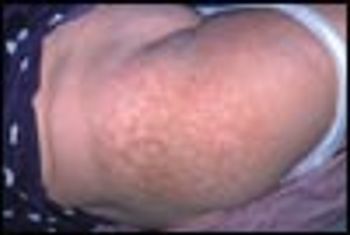
A 43-year-old woman with chronic hip pain presents with an asymptomatic eruption on the hip of several months' duration. She has been using a heating pad at night for pain relief because NSAIDs have not been effective.
A 43-year-old woman with chronic hip pain presents with an asymptomatic eruption on the hip of several months' duration. She has been using a heating pad at night for pain relief because NSAIDs have not been effective.

My patient is a woman in her late 30s who has several episodes a month of confluent facial erythema that is very warm to the touch and highly pruritic.
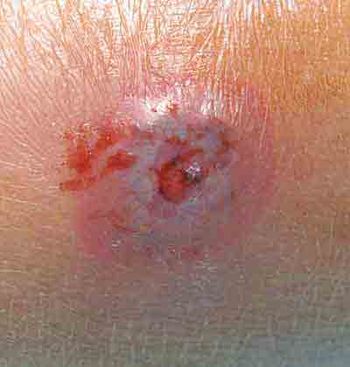
A previously healthy 40-year-old man complains of worsening lower-extremity discomfort. He noticed the discomfort several days earlier on awakening and thought that he had been bitten by a spider. The lesion, initially a small pustule, has enlarged into an open wound.
Dr Rosen invites you to match the clinical characteristics in the checklist with the disorders pictured in the photos. This month’s challenge: 2 leg lesions.
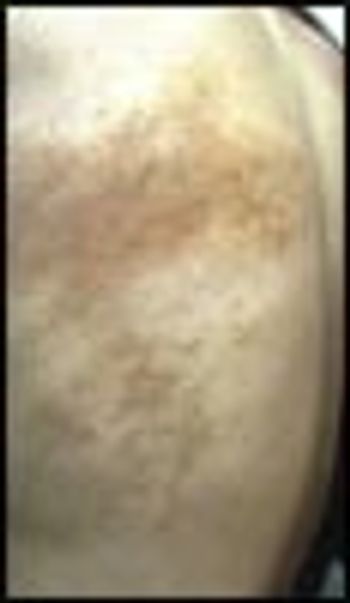
A 16-year-old boy with asymptomatic, hyperpigmented, hairy lesion on his left upper back. The pigmentation, first noted 5 years earlier, had progressively spread across his torso. The coarse and dark hair confined to the hyperpigmented area had appeared at age 13 years. Medical history uneventful. Review of systems showed no abnormalities. No family history of similar skin lesions.
When a patient complains of a “sore that won’t heal” or mentions that a lesion “constantly bleeds and scabs,” heed the advice of Osler.
Inside: a photo guide to the various manifestations of stasis dermatitis, irritant contact dermatitis, and allergic contact dermatitis-including diagnostic clues and treatment options.
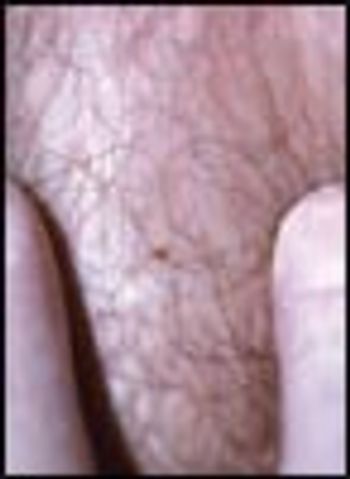
A 32-year-old woman presents for evaluation of itching in the pubic area.
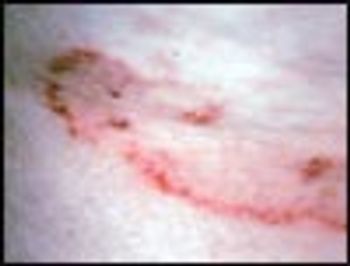
For 9 months, a 39-year-old woman has had a pruritic rash on the posterior portion of one thigh. She had consulted another physician, who prescribed a medication that she does not recall, but there was no improvement.
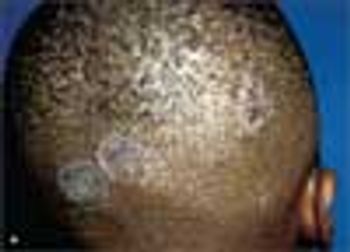
These scaly plaques on the scalp of a 32-year-old man have failed to respond to a topical antifungal. The patient has a 3-year history of pulmonary sarcoidosis.
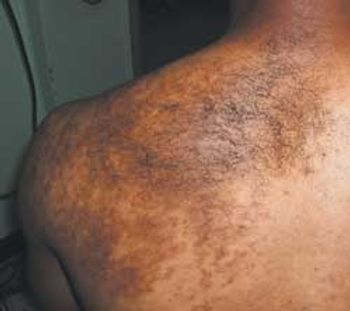
A 24-year-old man is concerned about a large, hairy "mole" on his left shoulder. The lesion appeared during adolescence as a group of small, dark blotches. These eventually coalesced into a hyperpigmented patch with hair and acne.
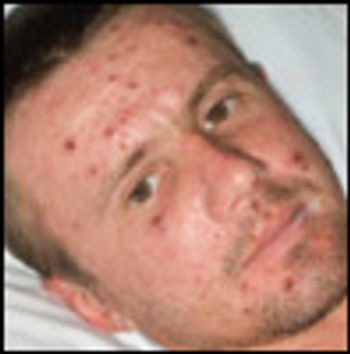
A 29-year-old Ukrainian man presents with a mildly pruritic generalized rash, which started 4 days earlier as a widespread eruption. The patient has no contacts who have a similar rash.
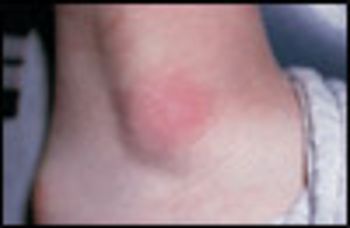
During a routine checkup, a 14-year-old girl inquires about a large red spot on her right ankle. The asymptomatic, erythematous area overlying the malleolus has been present for several months.
Because infants often start to cry as soon as a stethoscope makes contact with their skin, it can be difficult to hear defects during a cardiac examination.
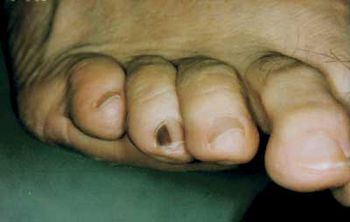
During a routine physical examination, a 3-mm dark brown streak is noted on the fourth toe of a 54-year-old man.
Here Dr Scheinfeld provides a pictorial guide to neurotic excoriation, perforating folliculitis, chondrodermatitis nodularis chronica helicis, hyperkeratosis, and intertrigo.
Apreviously healthy 47-year-old woman presents with an ascending, nonpruritic rash of 3 days’ duration on her legs. She reports that the rash began on her ankles following a day of gardening. She does not recall any recent insect bites and denies chest pain, dyspnea, abdominal pain, fever, arthralgia, arthritis, cough, and hemoptysis. She has never had a similar rash before. The patient’s only medication is an oral antihistamine for seasonal allergies. She has no known drug allergies.
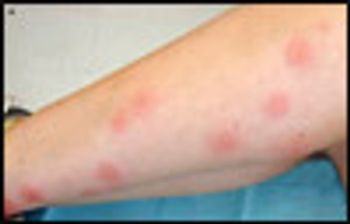
Intensely pruritic lesions of acute onset are evident on the legs of a 24-year-old woman who had no history of similar episodes. She was in excellent health and took no medications. She had spent the previous evening seated outdoors at a restaurant.
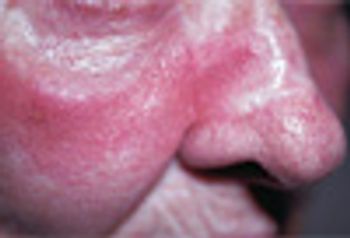
An itchy facial rash of 1 week's duration prompts a 72-year-old woman to see her primary care provider. She reports that redness and scaling had developed on her cheek, and that vitamin E oil she applied to the area seems to have made it worse.
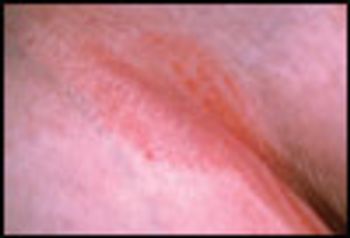
An obese 60-year-old woman presents with a chronic malodorous, itchy rash in her groin.
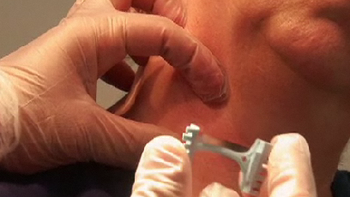
Dr Shroff, GP in Nottingham, demonstrates a shave biopsy.
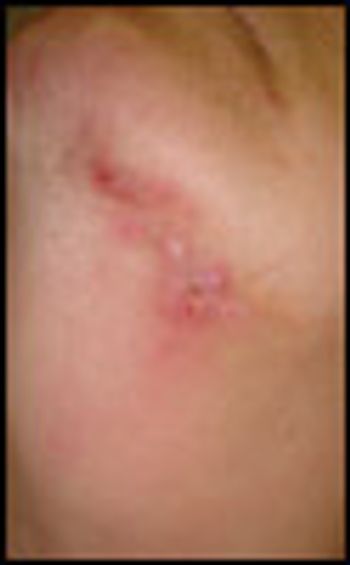
For more than a year, a 65-year-old woman had a nonpainful but nonhealing erythematous papule in the left submandibular area. She denied any unusual exposures or work history. Her most recent dental examination was several years earlier.
Match the following characteristics with the clinical disorders pictured in the photographs of Cases 1 and 2. Then read the brief descriptions that follow on the next page to see how well you did.
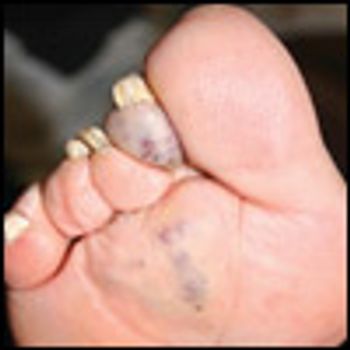
The plantar aspect of this toe shows purple nonuniform darkening that mimicked either a simple traumatic hematoma or the blue toe syndrome. More proximally, however, the solar aspect contained irregular dark-purple dots reminiscent of individual thrombosed venules, and in addition showed discontinuous purple zones more proximally in the part of the ray that lay within the body of the foot and that surely could not be imputed to any possible toe trauma or fracture nor to ischemia in the distribution of any single vessel. No purple area was warm or tender.
Because epidermal integrity decreases with age, eczematous inflammatory dermatoses are more common among older adults than among younger persons.