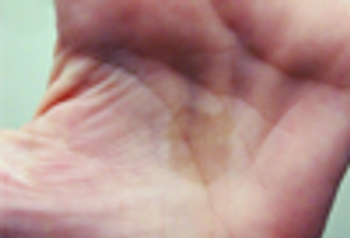
A 42-year-old homemaker noticed a discoloration on her palm. There were no symptoms, but she was greatly perturbed by her inability to wash this “dirt” off her skin . . .

A 42-year-old homemaker noticed a discoloration on her palm. There were no symptoms, but she was greatly perturbed by her inability to wash this “dirt” off her skin . . .

Here: Dr Rosen presents 5 tips about 5 skin disorders that you might not know.

Here: Dr Rosen presents 5 tips about 5 skin disorders that you might not know.

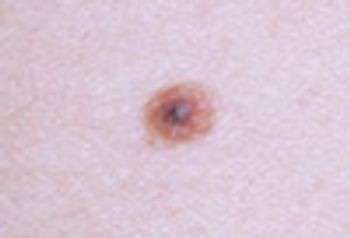
A 24-year-old woman presented with a chief complaint: “Check a funny mole.” Her boyfriend pointed out that a single mole on her back looked “different.”

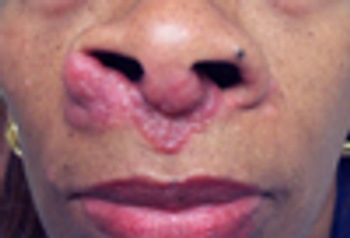
This 66-year-old black woman presented with a 2-year history of a painless skin eruption. She stated that her skin had “changed overnight” while she was caring for her mother who had been hospitalized.

Here: Ted Rosen, MD, presents 5 tips about 5 skin disorders that you might not know.

Here: Ted Rosen, MD, presents 5 tips about 5 skin disorders that you might not know.

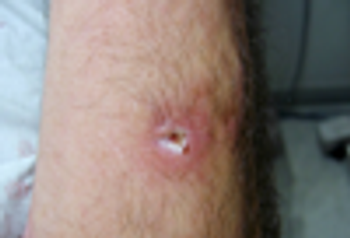
A 27 year-old woman was petting her cat, when the animal suddenly bit her on the arm. She rinsed copiously with isopropyl alcohol and applied an over-the-counter antibiotic ointment. But, 12 hours later, a large, red, swollen and exquisitely tender plaque had developed around the bite site.


Here: Ted Rosen, MD, presents 5 tips about 5 skin disorders that you might not know.

Following his routine rosacea follow-up visit, this 58-year-old man incidentally asked about a lesion on his left third digit. He pointed out a dime-sized, red, scaly patch on the dorsal aspect of the distal portion of the knuckle that extended toward the end of the finger.

An 8-year-old child has intensely pruritic lesions on the thumbs, adjacent dorsum of the hand, soles of the feet, and navel. Vital signs are normal. The patient is otherwise healthy and has no recent history of exposure to poison ivy.

Acanthosis nigricans is a nonspecific increase of the thickness of the prickle cell layer of the skin and most commonly seen in obese persons.

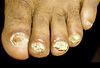
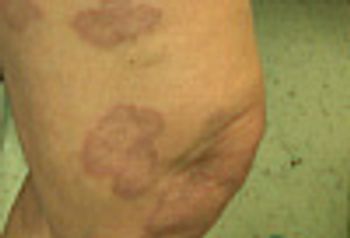
Match each picture with the phrase below that best describes it. The pathogenic organisms in these picturesmight be microscopic or macroscopic, and they can be recovered from skin lesions or clothing by the patientand/or clinician. Answers and discussion appear on the following page.

The mother of a 12-year-old boy is concerned about this dark mole on his neck. The asymptomatic lesion has been present for about 3 months.

During the past year, a 48-year-old man has had joint pain as well as this worsening rash on his hands. He is a construction worker, and he attributes the symptoms to his occupational exposure.

For several months, this 64-year-old man has had persistently dry lips despite frequent application of lip balm. He is otherwise healthy, and the lips are asymptomatic except for the dryness.

The mother of this 18-month-old boy brings him to your office for evaluation of a pigmented lesion of 2 months’ duration on the right anterior shoulder. When the lesion is rubbed, it becomes red and inflamed and occasionally a blister forms.

Here: a succinct review of the diagnosis and treatment of pemphigus vulgaris, dermatomyositis, cicatricial pemphigoid, linear IgA bullous disease, coma bullae, and stasis bullae.

A 56-year-old man has had progressive, erythematous plaques across the forehead and temples for the past few weeks. He describes these areas as “a little itchy and a little tender.”

After 6 weeks of scratching a very itchy, worsening rash on his left leg, a 53-year-old man seeks medical evaluation. He has tried over-the-counter (OTC) topical remedies with no success.

Certain papulosquamous and bullous diseases are more common in older adults than in younger persons. For example, bullous pemphigoid typically affects those in the fifth through seventh decades of life. Grover disease, or transient acantholytic dyskeratosis, is most common in white men older than 65.

Two skin carcinomas that are in close proximity can be removed in a single excision.

For 3 weeks, a 28-year-old man has had a pruritic, bilateral axillary rash. He stopped using deodorant, but the condition has not improved.

During a routine examination, these changes are noted on both thumbnails of a 56-year-old man. He denies any trauma or underlying diseases.