

























































































































Dermatology

Latest News


CME Content


Declining cardiovascular function, poor circulation, diabetes, obesity, cancer, immunodeficiency, renal disease, and thinned, xerotic skin provide the setting for a host of bacterial infections in elderly persons that can involve any level or structure of the skin.

This vesiculopustular eruption manifests with honey-colored crusted erosions. As it resolves, the crusts can turn brown; hyperpigmentation and scale may be evident.

Folliculitis, which features vesicles filled with white blood cells (pustules), usually affects hair-bearing sites, such as the scalp, neck, beard area, axillae, buttocks, and limbs.

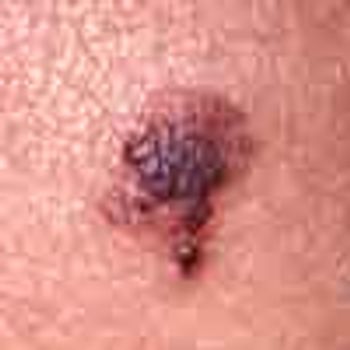
This lesion on her knee had been present for 5 years, reported a 22-year-old woman. It was not related to any trauma; its size had not changed, but occasionally it became darker or lighter. Excisional biopsy revealed lymphangioma circumscriptum, a benign, hamartomatous malformation of dilated lymph channels that may be filled with clear fluid because of communication with deeper lymphatics or, as in this case, serosanguinous fluid.

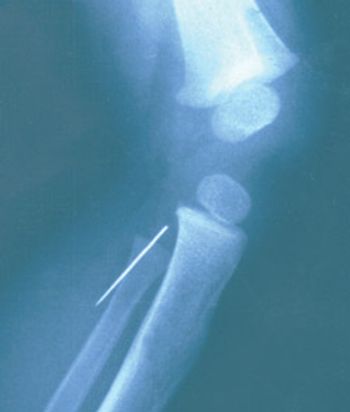
A thriving boy was brought to the office 3 weeks after his first birthday. His mother reported that there was something wrong with his knee. On visual examination, the knee appeared perfectly normal. On palpation, however, a 4-cm linear induration was evident over the knee fat pad, just medial and distal to the patella. It appeared soft, crepitant, and associated with the skin. No tenderness was noted on palpation; the infant did not object to palpation of this density any more than to auscultation, otoscopy, or anthropometric measurements.

To facilitate the assessment of jugular venous pressure, shine a beam of light tangentially across the skin overlying the jugular vein while the patient's neck muscles are relaxed.

Suggest that patients make a "rice sock" whenever they have a musculoskeletal injury, abscess, stye, or other condition that might benefit from heat therapy. Tell them to pour uncooked rice (the amount depends on the size of the area to be treated) into a clean cotton tube sock, tie off the open end of the sock, then microwave it for about 1 minute until warm (not hot). A rice sock holds heat longer than a hot towel and molds itself to the body part being treated.

This 3-mm, purplish pink papillary lesion with a crusted top had been present for 6 months at the outer vermilion border of the lower lip of a 65-year-old man. The lesion was asymptomatic.

A pruritic rash under the left breast has bothered a 67-year-old woman forthe past month. She takes an antihypertensive and is otherwise healthy.

A 52-year-old woman presents with a3-month history of a tender, erosivedermatitis on the nipples and in thevulvar/perineal region. Can youidentify these lesions?

For the past week, a 16-year-old boy has had a progressively worsening dry, irritating cough; dyspnea on exertion; and intermittent fever and chills. During the past 24 hours, he has had no appetite and has vomited greenish material 3 or 4 times.

A 32-year-old woman, who recently gave birth, seeks evaluation of 2 lesions onher neck. A linear, medium brown, warty, 4-cm lesion has been present sinceshe was born; there has been no disproportionate growth or change in color.The crusted 0.5-cm nodule at the most cephalad aspect of the linear lesiondeveloped in early pregnancy and has gradually enlarged.

A 67-year-old man complains of a lesion on the floor of his mouth that hasenlarged over the past year. When he touches the lesion, it bleeds easily andis friable and intermittently tender. The lesion has been present for manymonths; initially, it was a painless whitish area. The patient has no other lesionsin his mouth, and he has no dysphagia, dysarthria, or other problemsthat indicate oral dysfunction.

A 56-year-old African American man presents with a painful “raw” lip that hasgradually developed during the summer. Physical examination reveals a geographic,superficial erosion; notably, the erosion is surrounded by hypopigmentedand, most distally, hyperpigmented rings. The patient believes that exposureto sunlight has aggravated the condition.

For 3 months, a 41-year-old womanhas had a pruritic acneiform eruptionon the lateral aspects of the neck andthe left side of the face. She is otherwisehealthy and takes no medication.

A 51-year-old woman has had a progressiverash on the trunk, proximalarms, and legs for 2 weeks, followingthe latest round of chemotherapy forbreast cancer. Around the time thatthe rash erupted, she was also takinglevofloxacin for a productive cough.Cutaneous lupus erythematosus wasdiagnosed years ago, but she hasbeen disease-free for the past 5 years.Chemotherapy is being withheldpending diagnosis of the rash.

A 46-year-old man presents with right-sided facial paralysis. His symptoms beganthe previous evening when he had difficulty in closing his right eye; by morning,paralysis had developed. He also reports headache and mild photophobia.

To minimize pain when repacking anabscess, remove the old packing, thensquirt 1 mL of 1% lidocaine into theopen wound with a syringe (no needlenecessary).