























































































































































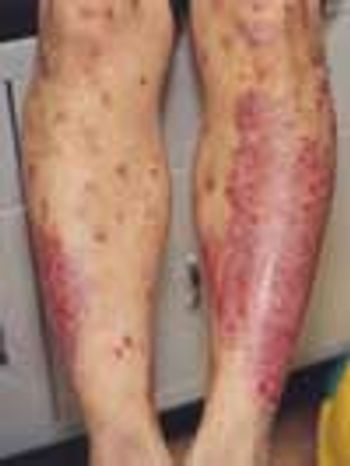
A 5-year-old girl is brought for evaluation of an asymptomatic inflamed streak on one leg that has been present for several weeks. She is otherwise healthy and takes no medications.
A 5-year-old girl is brought for evaluation of an asymptomatic inflamed streak on one leg that has been present for several weeks. She is otherwise healthy and takes no medications.
Children are at greater risk than adults for many travel-related problems, such as barotitis and barotrauma associated with flying, cold and heat injury, drowning, and infection with geohelminths. Most of these problems can be avoided with appropriate measures. Here, a summary of the most important steps.
The American Thoracic Society (ATS) and the Infectious Diseases Society of America recently published guidelines for the management of hospital-acquired pneumonia (HAP).1 These guidelines, which are an update of a 1996 ATS consensus statement,2 focus on bacterial HAP in immunocompetent adults. This includes ventilator-associated pneumonia (VAP) and health care-associated pneumonia (HCAP). Selected highlights are presented here.
Anorectal abscesses and fistulae, pilonidal disease, rectal prolapse, pruritus ani, and anal masses are discussed, with an emphasis on diagnosis and treatment of these conditions in the primary care office setting.
Anorectal complaints are commonly seen in primary care practice. The two most common anorectal conditions are hemorrhoids and anal fissures.
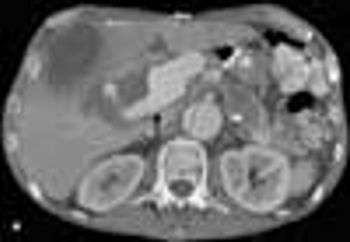
A 51-year-old man with a history of type B aortic dissection presented with severe right upper quadrant pain. He was febrile and hypotensive.
A 45-year-old woman presents for evaluation of increased pigmentation on the sides of her neck. The discoloration has been present for at least several months and is asymptomatic.
This case highlights the importance of detecting HIV infection in its earliest stages. Each year, 40,000 new cases of HIV infection are diagnosed in the United States; however, very few of these are identified at the acute infection stage. Diagnosis of primary HIV infection is important because it improves the patient's chances for a good outcome, reduces the risk of transmission, and provides epidemiologic data on virus strains in the community.
This 41-year-old woman rushed to the emergency department with a swollen, blistered tongue and difficultly in swallowing and speaking. Twenty minutes earlier she had eaten fish (for the first time in her life).
Patients with ear problems often pinchtheir nose and blow in an attempt toopen up and clear their ears.
Abstract: High-resolution CT (HRCT) can play an important role in the assessment of bronchiolitis. Direct signs of bronchiolitis include centrilobular nodules, bronchial wall thickening, and bronchiolectasis. Indirect signs include mosaic perfusion, hyperlucency, mosaic or diffuse airtrapping, vascular attenuation, and increased lung volumes. Expiratory HRCT scans are considered an essential part of the workup, because airtrapping may be evident only on these scans. In infectious cellular bronchiolitis, the centrilobular nodules typically have a branching, or "tree-in-bud," appearance, whereas in hypersensitivity pneumonitis, these nodules have a round or nonbranching pattern. The HRCT signs of constrictive bronchiolitis include mosaic perfusion, mosaic airtrapping, vascular attenuation, bronchiolectasis, and bronchiectasis; centrilobular nodules are usually absent. (J Respir Dis. 2005; 26(5):222-228)
Just how effective are the national guidelines for the management of community-acquired pneumonia (CAP)? Pretty good, according to Mortensen and associates. They found that compliance with practice guidelines, such as those published by the Infectious Diseases Society of America and the American Thoracic Society, is associated with a reduced mortality in patients with CAP.
CRS is the most common chronic disease in the United States, affecting 17.4% of adults, with an estimated direct cost of $5.6 billion yearly.1,2 There frequently is no definitive or quick cure. The clinical diagnosis of CRS is based on the presence and persistence of certain symptoms. The finding of mucosal thickening on coronal CT scan of the paranasal sinuses strengthens the clinical diagnosis.
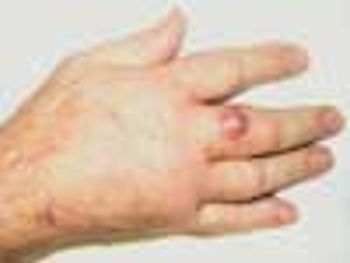
Three weeks earlier, a 65-year-old man had sustained lacerations on the dorsum of his right wrist and his right middle finger from a shattered glass door. He had self-treated the injuries. The laceration on his wrist healed, but the one on his finger became increasingly painful and swollen.
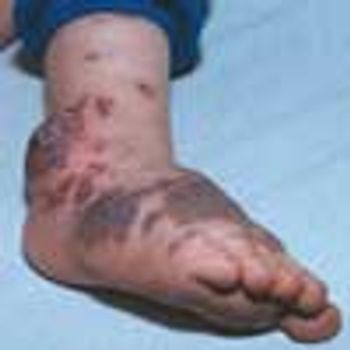
The parents of this 2-year-old boy brought their son for evaluation of swelling of the right leg and excoriation and serosanguineous discharge from the ankle region of 3 days' duration.The child had had a hemangioma of the right ankle since birth. Subsequently, there was gradual spread of the lesion along the leg to the buttocks.
What is the best way to obtain skin scrapings and evaluate them for evidence of fungal infection?
A 65-year-old woman with well-controlled hypertension comes in for a routine checkup. During the past 10 years, she has gained 25 lb and lost 1.5 inches in height.
Excessive sweating may be caused by a variety of conditions or prescription drugs.
A slowly progressive rash; pruritic lesions in the antecubital fossae; circular scaling, erythematous plaques--can you identify the disorders pictured here?
Abstract: In most patients, a life-threatening exacerbation of asthma is preceded by a gradual worsening of symptoms. However, some patients have a sudden onset of worsening symptoms, and these patients are at increased risk for respiratory failure and death. Risk factors for near-fatal asthma include a history of a life-threatening exacerbation, hospitalization for asthma within the past year, delay in time to evaluation after the onset of symptoms, and a history of psychosocial problems. Regularly monitoring peak expiratory flow rate (PEFR) is particularly important because it can identify a subset of high-risk patients--specifically, those with large fluctuations in PEFR and those who have severe obstruction but minimal symptoms. Signs of life-threatening asthma include inability to lie supine, difficulty in speaking in full sentences, diaphoresis, sternocleidomastoid muscle retraction, tachycardia, and tachypnea. (J Respir Dis. 2005;26(5):201-207)
The prevalence of asthma in the United States is estimated to be 5% to 8%. Asthma is responsible for approximately 5000 deaths annually in this country. It is a leading cause of emergency department visits, hospitalizations, and school and work absenteeism. The total estimated direct cost of the disease in the United States was $12.7 billion in 1998.
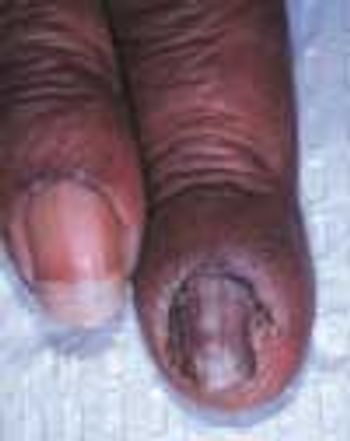
A 70-year-old woman complained of an infection in the right index fingernail and surrounding skin of 18 months' duration. The modest swelling and tenderness of the proximal paronychial tissue, faint nail dystrophy, and separation of the cuticle from the nail plate had persisted despite several courses of oral and topical antibiotics. The patient had occasionally seen pus seeping from underneath the cuticle. Results of a bacterial culture, performed by another physician, were negative.
A 13-year-old boy presented with an explosive eruption of numerous, small, round, erythematous, itchy plaques on his lower back and lower limbs of 2 weeks' duration. Some of the lesions were scaly. His nails were normal. There was no evidence of arthritis or joint deformity. He had a sore throat a month before the onset of the rash but did not seek medical attention. He was not taking any medication and had no history of joint pain or family history of skin problems.
A 68-year-old man presents to the emergency department with diplopia and headache of acute onset accompanied by nausea and vomiting.
In Dr Henry Schneiderman's interesting case of swelling and redness of the lids in an elderly woman, the photograph clearly illustrates a sharp demarcation of the area of swelling above the cheekbone.