




















































































ain management is a commonand challenging aspect of caringfor elderly patients. The principlesthat guide therapeutic pain managementin these persons are differentfrom those used in the treatmentof younger persons.

ain management is a commonand challenging aspect of caringfor elderly patients. The principlesthat guide therapeutic pain managementin these persons are differentfrom those used in the treatmentof younger persons.

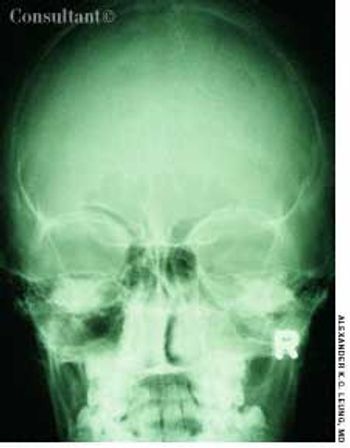
The patient is a 56-year-old man who presents with daily headaches that occurbehind the right eye, right temple, and occasionally on the right side of theforehead. He has never experienced this type of headache on the left side. Hedescribes the pain as “stabbing,” “throbbing,” and occasionally “burning.”He rates the intensity of the pain a 7 on a 10-point visual analog scale onwhich 10 is the most severe.

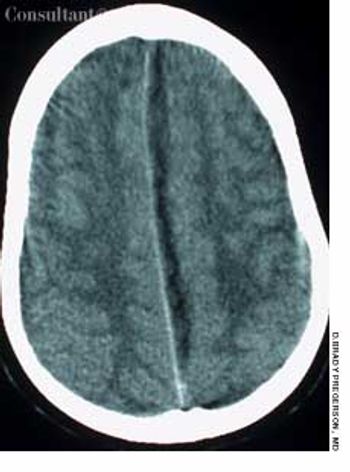
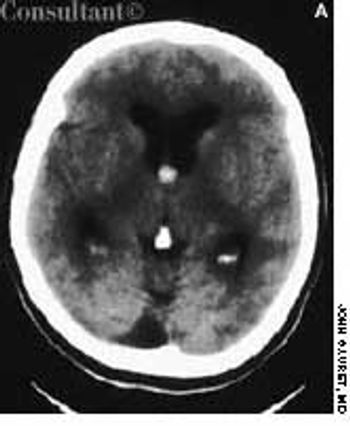
A 69-year-old man with an acute severe headache and nausea was brought to the emergency department. The patient was neurologically intact; an intracerebral hemorrhage was suspected.

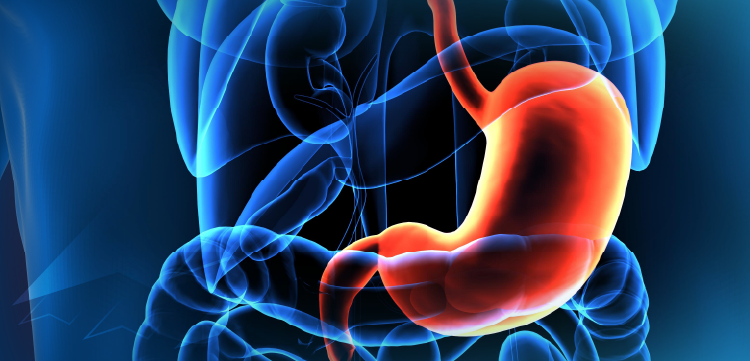
Excessive belching, abdominal bloating, and flatulence caused an 89-year-old woman to seek medical attention. She reported that these previously mild and intermittent symptoms of 20 years’ duration had worsened during the last 2 years.

For 2 weeks, a 59-year-old woman had experienced weakness on the left side of her face. She described her appearance as "deviated" and complained of dribbling from the corner of her mouth and difficulty in chewing. The patient was unable to close her left eye and said that noises sounded unpleasantly loud and distorted in the left ear. She denied earache, vertigo, fever, headache, and rash.

Many patients who present to the emergency department(ED) with severe headache request a narcotic to relieve thepain.

You recently diagnosed migraine without aura in a patient who complains of headaches of moderate intensity. Is a migraine-specific prescription agent warranted?

A 34-year-old woman complains of headaches that interfere with work. Her first headache episode, approximately 6 yearsearlier, was relatively mild. Initially, she experienced attacks only once every 3 to 4 months and managed them effectivelywith over-the-counter (OTC) agents. However, in the last 6 months the attacks have become more frequent-they occur atleast twice a month-and are so severe that she misses work.

In their case report, “Sudden Headache in a Woman With Hypertension” (CONSULTANT,July 2002, page 1049), Drs Gary Quick and Maggie Law describe apatient with uncharacteristically severe headache and very high blood pressure.

Calcium channel blockersare commonly prescribedto treat severalcardiovascular diseasesand may be helpful inother conditions, such as migraineand bipolar disorder.1 These agentsare associated with numerous clinicallysignificant drug interactions.1-3While some of these interactions,such as the effect of verapamil onserum digoxin concentrations, arewell-known, others are not widely recognized-yet warrant attention.

A 77-year-old man is brought to the emergency department after severaldays of illness that began with fever, nausea, emesis, and headache. Muscleweakness and associated myalgia developed; the weakness became so severethat the patient needed help to get out of bed and walk to the bathroom.The day before he came to the hospital, he slept much of the time and wasdifficult to arouse.

A 69-year-old retired accountant presents with a 2-month history of daily headaches. The pain is moderate, constant,global, pressure-like, and occasionally pulsating; it is sometimes exacerbated when the patient lies down. He denies nauseaor vomiting, ocular symptoms, weakness, or sensitivity to light. His wife reports that years ago he experienced throbbingheadaches regularly.

ABSTRACT: A thorough history and physical examination can establish the diagnosis of tension headache; further evaluation is generally unnecessary. In contrast, the workup of cervicogenic headache includes standard radiographs, 3-dimensional CT, MRI, and possibly electromyography; nerve blocks may also be used to confirm the diagnosis. Episodic tension headache can be treated effectively by trigger avoidance, behavioral modalities, and structured use of analgesics. Reserve opioids for patients with intractable headaches. Chronic tension headache is treated primarily by prophylactic measures, such as antidepressants and anticonvulsants, and behavioral and physical therapy. Treatment options for cervicogenic headache include analgesics; invasive procedures, such as trigger point injections, greater or lesser occipital nerve blocks, facet joint blocks, segmental nerve root blocks, and diskography; spinal manipulation; and behavioral approaches.

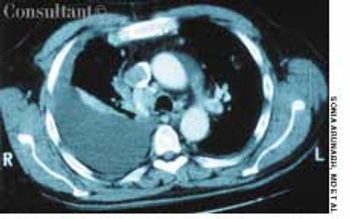
A 64-year-old woman with a history of diabetes, hypertension, and lymphoma was admitted to the hospital with a dull headache, conjunctival congestion, and slight dyspnea. Her pulse rate was 96 beats per minute; blood pressure, 146/68 mm Hg; and respiration rate, 22 breaths per minute. She also had increased jugular venous distention; cardiovascular and chest examination findings were normal. Edema of both arms and dilated blood vessels on the anterior chest wall were noted.

A bright, active 10-year-old boy has been experiencing recurrent bouts ofabdominal pain with nausea and occasional vomiting for 3 years. Although hehas had 1 or 2 attacks at school, the pain usually occurs at home-frequentlyon weekends. His mother has been unable to correlate these episodes with particularfoods or activities. She notes that her son has experienced motion sicknessduring long auto trips and during a family holiday in the mountains ofColorado.

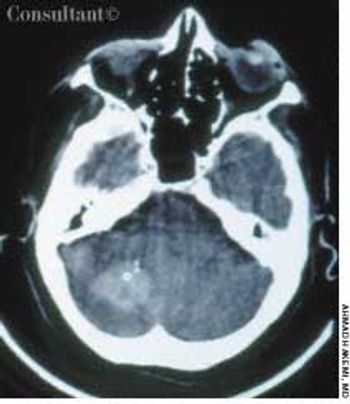
A 65-year-old woman with a long history of hypertension treated with metoprolol and felodipine complained of dizziness, headache, nausea, and vomiting of acute onset. Her blood pressure was 220/110 mm Hg. She was drowsy and unable to stand or walk.

A 28-year-old man presents tothe emergency departmentwith high fever; progressive, severe,generalized, throbbing headache;blurred vision; and increasingconfusion. These symptoms started3 days earlier.

A 37-year-old woman presents to the emergency departmentwith a diffuse, sharp, pounding headache,which started 2 hours earlier. She rates her discomfort as4 on a scale of 1 to 10. Neck muscle soreness is also present,but the pain does not radiate.

Is there a meaningful percentage of patients who contract Lyme disease but havenone of the early symptoms-neither the rash nor the flu-like symptoms (eg, fever,myalgia, headache, and stiff neck)-and in whom the disease only becomes clinicallyevident in a later stage when it is much harder to treat?

Three strategies have commonly been used for episodic migraine. In step care across attacks, the least expensive medications are tried for several episodes. If these fail, treatment is "stepped up" to specific agents.

Migraine is an episodic, often debilitatingcondition that affects women moreoften than men. Twenty-eight millionAmericans suffer from migraineheadaches-and nearly 75% of theseare women.1 Unlike other chronic painconditions, migraine has its peakprevalence during the years of greatestproductivity, when most women arejuggling family responsibilities andcareers.2 Many women are particularlysusceptible to migraine attacks justbefore and during menses.

A 49-year-old woman was admitted tothe hospital with a high fever ofabrupt onset, rigor, headache, myalgias,and profound prostration. Hertemperature was 41ºC (105.8ºF);blood pressure, 60/40 mm Hg; respirationrate, 30 breaths per minute;and pulse rate, 130 beats per minute.

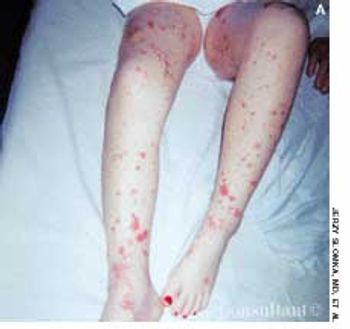
A 30-year-old man presented with a few-day history of aviral prodrome, including a low-grade fever, mild headache,muscle and joint aches, and malaise, accompaniedby a vesiculopapular rash. The mildly pruritic eruptionbegan on the head and neck and progressed within 36hours to the trunk and proximal extremities; the palmsand soles were spared.