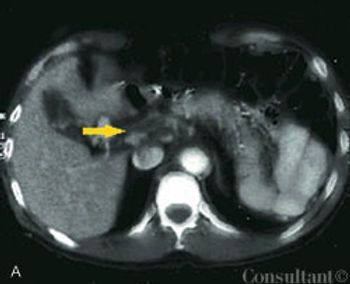
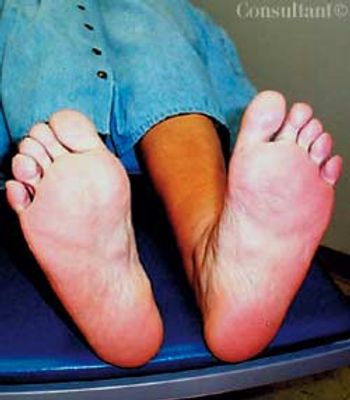
A 72-year-old man slipped and fell backward in the bathroom, hitting hishead on the toilet seat; he suffered only minimal discomfort. The followingday, he presented with mild back pain and extensive bruising.

A 72-year-old man slipped and fell backward in the bathroom, hitting hishead on the toilet seat; he suffered only minimal discomfort. The followingday, he presented with mild back pain and extensive bruising.

About 1 month ago, a 58-year-old man experienced malaiseand fatigue accompanied by mild diffuse swelling in his neck.After 3 days, the malaise and fatigue began to abate. They resolvedafter a week; however, minimal swelling on the left sideof the neck remains. The patient has no other symptoms.

Q:Many of my patients appear to have white-coathypertension: their pressure is elevated whenmeasured in my office-but normal when measured athome. Am I ignoring significant hypertension if I do nottreat these patients? Or am I overtreating if I do treat?

Over the past 20 years, obesity has reached epidemic proportions in the United States and throughout the world. The need for effective prevention and treatment is thus more urgent than ever.

For 2 months, a 31-year-old woman had had dyspnea anddull, continuous retrosternal pain. She was admitted to thehospital, and a helical CT scan of the thorax identified asaddle pulmonary embolism. An ultrasonogram revealeddeep venous thrombosis (DVT) in the left leg. Intravenousheparin was given; the patient was discharged,and warfarin was prescribed.

A 72-year-old man presented after several months of dyspepsia and 1 day of hematemesis. He was not taking NSAIDs.

The past several years have witnessedimportant advances in the evaluationand management of chronic heart failure(HF). Drugs such as β-blockersand spironolactone have been shownto reduce morbidity and mortality, andstrategies that employ new devices,such as pacing and defibrillator therapy,are evolving. This has promptedthe American College of Cardiology(ACC)/American Heart Association(AHA) to update guidelines first publishedin 1995.1 The guidelines highlightthe importance of early and accuraterecognition of the clinical syndromeof chronic HF and offer anoutline for evidence-based therapeuticdecision making.

Although the cardiovascular death ratehas declined in the United States, thenumber of hospitalizations for cardiacdisease has not. The improvement incare has been offset by an increase inthe number of older Americans. By2050, more than 100 million Americanswill be 60 years of age or older,and about 30 million will be older than80 years.

A 25-year-old man presented with an erythematous, pruritic, scaly, macular rash that had begun behind his ears and spread over his neck, chest, trunk, and upper and lower extremities.