
























































































































































Cardiology

Latest News


CME Content


A 65-year-old woman with a long history of hypertension treated with metoprolol and felodipine complained of dizziness, headache, nausea, and vomiting of acute onset. Her blood pressure was 220/110 mm Hg. She was drowsy and unable to stand or walk.

Heart failure(HF), the mostcommon Medicarediagnosisrelatedgroup,has a significant and growingimpact on health careresources. The incidenceof HF has tripled during thelast decade. Almost 5 millionAmericans have HF, and anestimated 500,000 new casesare diagnosed yearly. Thelifetime risk of HF is about20%.1 Drug therapy has improvedconsiderably in recentyears, but the magnitudeand severity of theproblem has created a needfor newer therapies--particularlysince HF is associatedwith an increased risk ofsudden death and a diminishedquality of life.2

A 58-year-old man recently underwent coronary artery bypass graft (CABG)surgery after emergent cardiac catheterization for a myocardial infarction revealeddiffuse 3-vessel disease.

Dr Gregory Rutecki's interactive teaching case, “A Middle-Aged Man WithPolyuria: The Initial Visit” (CONSULTANT, March 2001, page 357), provided awelcome opportunity for me to review the care I provide to my patients with type 2diabetes, who comprise a very large percentage of my practice.

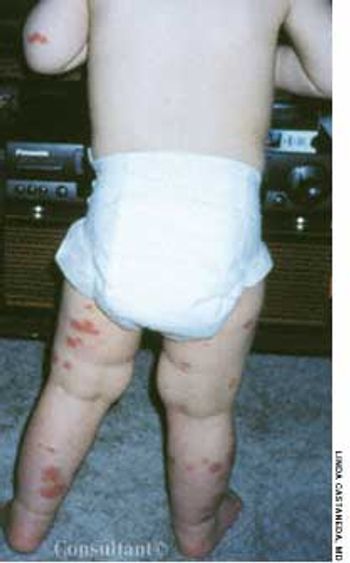
An otherwise healthy 18-month-old boy presented with palpable purpura over the legs, arms, and buttocks; his face, neck, and trunk were spared. The patient was otherwise asymptomatic, alert, and playful. His mother reported that the child had a “stuffy nose and cough” 1 month earlier.

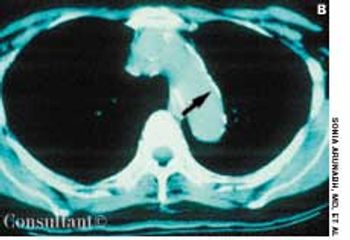
For 2 months, a 31-year-old woman had had dyspnea anddull, continuous retrosternal pain. She was admitted to thehospital, and a helical CT scan of the thorax identified asaddle pulmonary embolism. An ultrasonogram revealeddeep venous thrombosis (DVT) in the left leg. Intravenousheparin was given; the patient was discharged,and warfarin was prescribed.

This patient with long-standing insulin-dependent diabetes has difficultyclosing his hand because of “tight skin.” Diabetes is the cause: this findingoccurs more often in persons with microvascular complications, such asretinopathy and nephropathy. The condition may occur even in patients withwell-controlled diabetes.

The past several years have witnessedimportant advances in the evaluationand management of chronic heart failure(HF). Drugs such as β-blockersand spironolactone have been shownto reduce morbidity and mortality, andstrategies that employ new devices,such as pacing and defibrillator therapy,are evolving. This has promptedthe American College of Cardiology(ACC)/American Heart Association(AHA) to update guidelines first publishedin 1995.1 The guidelines highlightthe importance of early and accuraterecognition of the clinical syndromeof chronic HF and offer anoutline for evidence-based therapeuticdecision making.

This patient with long-standing insulin-dependent diabetes mellitus has difficulty in closing his hand because the skin is "very tight."

Levofloxacin, 500 mg/d, had been prescribed for a 74-year-old woman who had a urinary tract infection. The patient had type 2 diabetes and hypertension. She was allergic to sulfa drugs. Two hours after taking the first oral dose of the antibiotic, painful blisters developed on the lower lip and soft palate.

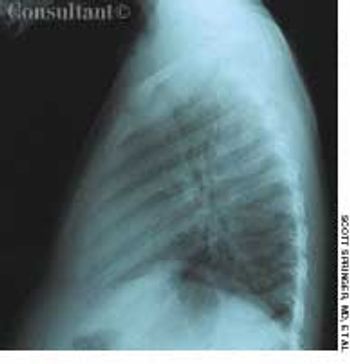
The mother of an 8-year-old girl sought medical care for her daughter who had complained of intermittent chest pain for 3 days. The patient denied nausea, vomiting, and diarrhea. There was no shortness of breath, chills, fever, or diaphoresis.

Although the cardiovascular death ratehas declined in the United States, thenumber of hospitalizations for cardiacdisease has not. The improvement incare has been offset by an increase inthe number of older Americans. By2050, more than 100 million Americanswill be 60 years of age or older,and about 30 million will be older than80 years.